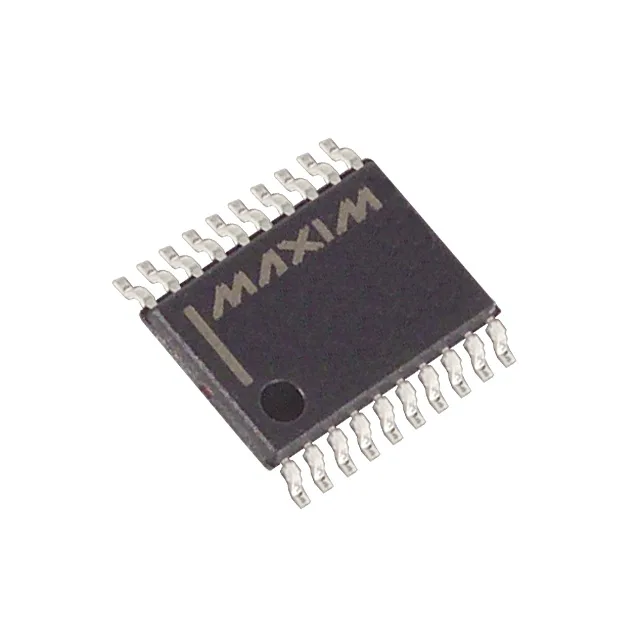
Six pots in one package — what the DS3930E+T&R brings to the bench
It communicates over an I²C bus and stores the wiper setting in non-volatile memory, so the position is retained after power is cycled.
With 256 taps, each step changes the wiper-to-terminal resistance by roughly 64.5Ω (16.5kΩ / 255 steps). That gives you about 0.39% resolution per step — fine enough for most audio volume controls, programmable voltage references, or sensor bias trims. The linear taper means the resistance changes linearly with the digital code; if you need a logarithmic (audio) taper, you either handle it in software or pick a different part. The temperature coefficient is ±250 ppm/°C typical. For a 16.5kΩ pot, that works out to about ±4.1Ω per degree Celsius. In a precision analog path where the resistor ratio matters more than the absolute value, this is usually fine — but if you're trimming a critical reference, the tempco of the external resistors around the pot will dominate anyway. Six independent channels in a single 20-TSSOP package saves board space compared to using three dual-channel pots or six single-channel ones. The I²C interface uses two wires (SDA, SCL) plus the address pins, and the selectable address feature lets you put up to eight of these on the same bus, giving you 48 channels under one I²C master.
Temperature range and where you can run it
The non-volatile memory is a key feature for set-and-forget applications: you program the wiper position once during calibration, and it stays there through power loss. No need for a microcontroller to reload the setting at every power-up, which also saves a few lines of firmware.