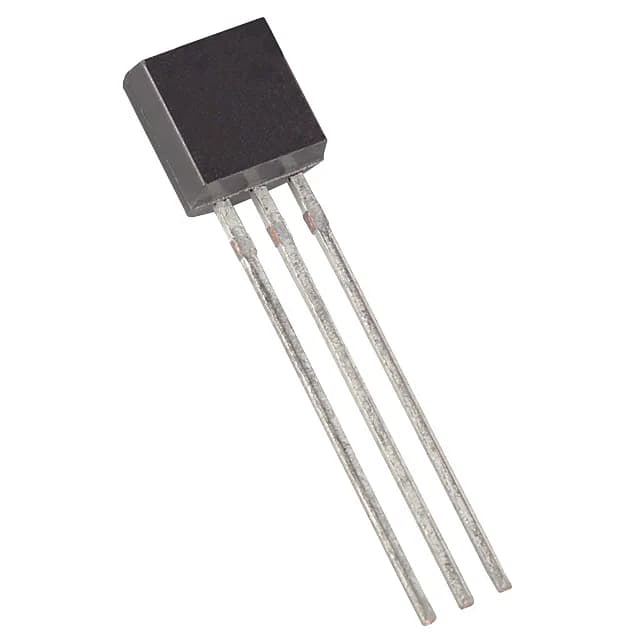
20Kbit 1-Wire EEPROM — what it is and where it fits
The Maxim Integrated DS28EC20+ is a 20Kbit non-volatile EEPROM that communicates over a single-pin 1-Wire interface. The 20Kbit memory is organized as 256 x 80 bits, giving you 256 pages of 80 bits each — a structure suited for storing calibration constants, serial numbers, security keys, or configuration profiles rather than bulk data. The 1-Wire bus means only one data line (plus ground) connects the device to a host microcontroller, which simplifies cabling and frees up GPIO pins in space-constrained designs. The through-hole TO-92-3 package is a legacy form factor common in retrofit applications, breadboard prototyping, and low-to-medium volume production. The operating temperature range of -40°C to 85°C covers industrial control and outdoor telecom environments.
1-Wire interface — the single-pin trade-off
The 1-Wire interface uses a single data pin for both power and communication. The host requires a 1-Wire master, which many microcontrollers support via a built-in controller or bit-banged GPIO.
Active production — no LTB risk
For BOM planning this means you can qualify it into new designs without worrying about a near-term obsolescence-driven redesign. The part is ROHS3 compliant, so it meets the current European RoHS exemption-free requirements.
No external components needed for basic operation
The 1-Wire interface derives its power from the data line itself (parasitic power), so the DS28EC20+ requires no external power supply capacitor or pull-up resistor beyond the standard 1-Wire pull-up on the host side. For a typical host microcontroller with a 1-Wire master, the only additional component is a single 4.7 kΩ pull-up resistor on the data line. No external decoupling capacitor is needed because the device draws its operating current from the bus during the active time slot.
Raspberry Pi and general host compatibility
The DS28EC20+ can be used with a Raspberry Pi or any host that supports a 1-Wire interface. On a Raspberry Pi, the 1-Wire protocol is supported via the Device Tree overlay (w1-gpio) on any GPIO pin, typically BCM4 (pin 7). The 4.7 kΩ pull-up resistor to 3.3 V is required on the data line. The Linux kernel's w1 subsystem automatically detects the DS28EC20+ by its family code and exposes the memory as a sysfs entry, so reading and writing the 20Kbit memory is straightforward from userspace. The same approach works on any Linux SBC or microcontroller with a bit-banged 1-Wire implementation.