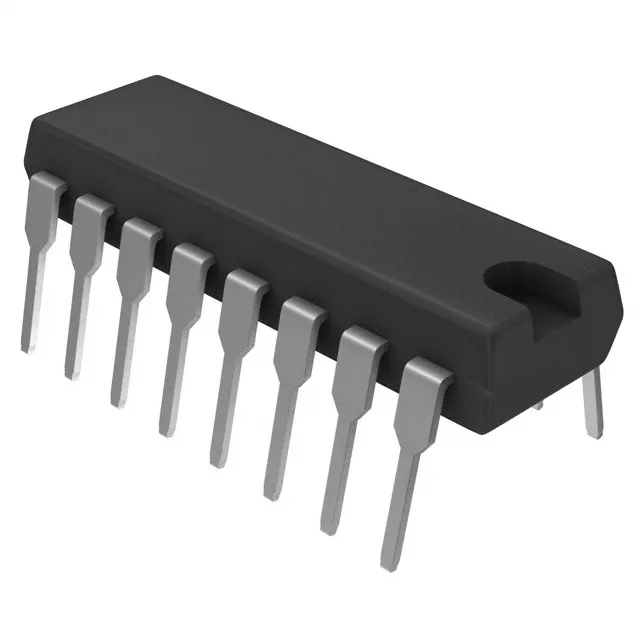
Analog Devices DG444DJ+ — Microcontrollers & Processors (MCU / MPU / DSP)

Analog Devices DG444DJ+ SPST-NC Switch, 85Ω, 16-DIP

MPNDG444DJ+
End of Life

Analog Devices DG444DJ+, quad SPST-NC analog switch, 85 Ohm on-resistance, 16-DIP (0.300", 7.62mm) through-hole package, -100dB crosstalk @ 1MHz.

$8.61Ref. price · indicative, final on quote
Packaging16-DIP (0.300", 7.62mm)
StockContact for availability
Lead timeIn Stock wk
MOQ1 pcs
  • 100% new & originalTraceable channels only — no refurbs, no pulls, no remarked parts.
  • Date & lot codes on quoteStated per line before you commit; label photos on request.
  • MSL-compliant ESD packingMoisture-sealed bags with indicator cards; reels photo-verified.
  • PayPal buyer protectionPay by T/T, PayPal or Payoneer — card payments covered end to end.

Specifications

DG444DJ+ Technical Specifications
ParameterValue
Mounting typeThrough Hole
Voltage - supply, dual (V±)±4.5V ~ 20V
Voltage - supply, single (V+)10V ~ 30V
Current - leakage (IS(off))500pA
Operating temperature-40°C ~ 85°C (TA)
PackageTube
Crosstalk-100dB @ 1MHz
Case16-DIP (0.300\", 7.62mm)
Switch circuitSPST - NC
Charge injection5pC
Number of circuits4
On-State resistance85Ohm
Switch time (Ton, toff)250ns, 140ns
Multiplexer (Demultiplexer circuit)1:1
Channel capacitance (CS(off), CD(off))4pF, 4pF
Channel-to-Channel matching (ΔRon)4Ohm (Max)

Product details

Quad SPST-NC switch with 85Ω on-resistance

The DG444DJ+ is a quad SPST-NC (normally-closed) analog switch from Analog Devices, packaged in a 16-pin DIP (0.300", 7.62mm) through-hole package. Each of the four switches presents a maximum on-resistance of 85Ω, with channel-to-channel matching held to 4Ω max — tight enough that gain errors in a multiplexed signal chain stay within a few millivolts across channels. The normally-closed topology means the switch conducts when the control voltage is low — a useful fail-safe in applications where the signal path should remain connected if the logic supply drops or the controller resets.

Supply flexibility and signal integrity

The part runs from either a single supply (10 V to 30 V) or dual supplies (±4.5 V to ±20 V), making it adaptable to both single-rail systems and bipolar analog front-ends. The wide supply range covers common industrial rails like ±12 V, ±15 V, and 24 V single-ended without needing a separate regulator. Switching speed is 250 ns on, 140 ns off (max) — fast enough for audio muting, sample-and-hold front-ends, or relay-replacement in low-speed data acquisition. Crosstalk between channels is -100 dB at 1 MHz, so a 10 Vpp signal on one channel couples less than 100 µV into an adjacent channel — adequate for 16-bit systems at moderate frequencies. Charge injection is 5 pC typical, which translates to a voltage glitch of about 1.25 mV into a 4 pF load capacitance — low enough that downstream sample-and-hold circuits or precision integrators see minimal pedestal error. Off-state leakage is 500 pA max, and off-capacitance is 4 pF per channel — both figures keep the signal path high-impedance when the switch is open, preserving accuracy in high-source-impedance applications like photodiode amplifiers or pH probe interfaces.

Through-hole DIP for prototyping and legacy designs

Housed in a 16-pin PDIP (0.300" body width), the DG444DJ+ is a through-hole part — the same footprint used by the original DG444 series. It is a natural fit for breadboarding, socketed test fixtures, or legacy board spins that already carry the DIP footprint.

Frequently asked questions

What is the crosstalk specification of the DG444DJ+?

The DG444DJ+ has a crosstalk of -100 dB at 1 MHz between channels. This means a 10 Vpp signal on one channel couples less than 100 µV into an adjacent channel, suitable for 16-bit signal chains at moderate frequencies.

What package does the DG444DJ+ come in?

The DG444DJ+ is supplied in a 16-pin DIP (0.300", 7.62mm) through-hole package, specifically a 16-PDIP. It is delivered in tube packaging.

What is the on-resistance and channel matching of the DG444DJ+?

Maximum on-resistance is 85Ω per channel, with channel-to-channel matching guaranteed to 4Ω max. This tight matching keeps gain errors across channels in a multiplexed system within a few millivolts.