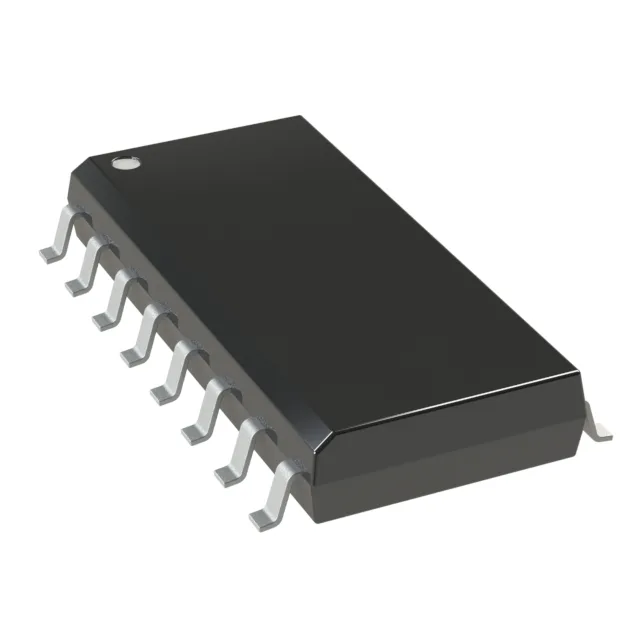
The DG413EUE+: ROHS3 compliant, so it ships without lead, mercury, cadmium, or other restricted substances per EU Directive 2011/65/EU. No special handling or exemption paperwork needed for global shipments.
45 Ohm on-resistance and switching speed — signal path limits
For a 10 mA signal, the drop is 450 mV; for precision analog paths, the load impedance should be at least 10x higher than Ron to keep attenuation below 1%. The 3 Ohm max channel-to-channel matching means all four switches track within that band — useful for gain-matched multiplexer stages. Switching times are 175 ns max turn-on, 145 ns max turn-off. This 320 ns total cycle sets the maximum multiplexing rate at roughly 3 MHz before the output settles to within spec. For audio-frequency switching (up to 20 kHz) the margin is generous; for video or high-speed data paths, the timing budget needs a closer look.
Crosstalk and charge injection — analog signal integrity
Crosstalk is -85 dB at 1 MHz — the isolation between channels at that frequency. For a 1 Vpp signal on one channel, the coupled signal on an adjacent channel is about 56 µVpp. This is adequate for 12-bit systems; for 16-bit or higher, the noise floor from crosstalk may limit the usable dynamic range at higher frequencies. Charge injection is 5 pC — the amount of charge dumped onto the load when the switch turns off. For a sample-and-hold capacitor of 10 nF, this creates a 0.5 mV step. In precision acquisition circuits, the injection error adds to the hold-step and must be budgeted into the system offset.
Supply rails and temperature — operating envelope
The wide range lets the part work in systems with 12 V, 15 V, or 24 V rails without an extra regulator. With ±15 V supplies, the switch handles analog signals up to ±15 V peak. This covers most factory-floor, instrumentation, and telecom environments. The leakage current (250 pA max off-state,) and channel capacitance (9 pF each side,) are specified across this range — expect leakage to increase near the upper temperature limit, but the 250 pA ceiling keeps it manageable for high-impedance circuits.
16-TSSOP package — board integration
The 16-TSSOP package has a 0.65 mm pitch and 4.4 mm body width — a compact footprint that fits on two-layer boards with careful fan-out. The body is thin (1.2 mm max seated height), suitable for mezzanine or card-edge applications where height is constrained. For prototype builds or low-volume production this is fine; for high-volume pick-and-place, request the tape-and-reel variant (DG413EUE+T) to avoid tube-feeding issues.