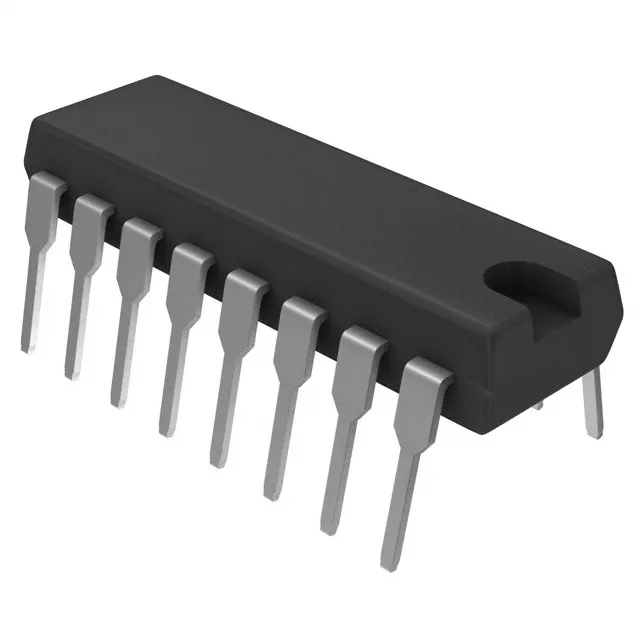
The DG409DJ+: The 16-PDIP footprint is a legacy workhorse — no fine-pitch alignment needed, and the 100-mil row spacing keeps layout straightforward on two-layer boards. The through-hole body handles rework cycles well, but the 16-DIP's thermal resistance is higher than a surface-mount equivalent — keep the ambient airflow in mind if the switch is near a hot regulator or power stage.
Switch topology and key parametrics
The DG409DJ+ integrates two independent SP4T (single-pole, four-throw) switches, each configurable as a 4:1 multiplexer or 1:4 demultiplexer. With a maximum on-resistance of 100 ohms and channel-to-channel matching of 1.5 ohms, the signal attenuation and skew between channels stay tight — useful for routing analog signals like audio or low-frequency sensor outputs where gain matching matters. Switching time is 150 ns for both turn-on and turn-off, which sets the channel-switching rate ceiling at roughly 3.3 MHz for a 50% duty cycle. The -92 dB crosstalk at 100 kHz means that a signal on one channel couples less than 0.0025% into an off channel — a clean enough floor for 16-bit data acquisition systems.
Supply rails and signal-handling limits
The dual-supply mode lets the switch pass bipolar signals without level-shifting — the analog signal range tracks the supply rails. Charge injection is 2 pC typical, so glitch energy during channel switching is low enough that a downstream sample-and-hold sees minimal offset shift. Off-channel leakage is 500 pA maximum, and off-capacitance is 14 pF on the drain side. For a 10 kΩ source impedance, the leakage-induced offset is under 5 µV — negligible in most precision circuits. The 3 pF source capacitance keeps the RC time constant short, preserving bandwidth through the mux.