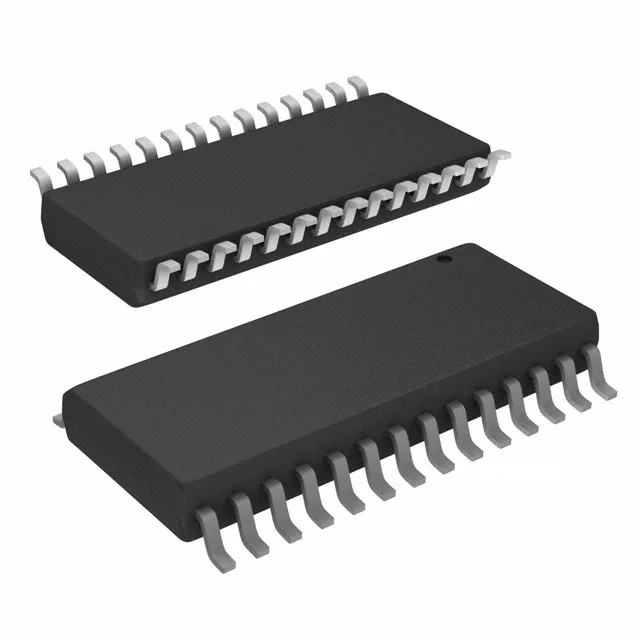
16:1 multiplexer, 100 Ohm on-resistance
The DG406CWI+T: On-state resistance is a maximum 100 Ohm, with channel-to-channel matching held to 1.5 Ohm — the delta between channels stays tight enough that gain error across a multi-channel data-acquisition front-end is dominated by the external op-amp, not the mux. Switching times are 200 ns turn-on and 150 ns turn-off, which keeps the mux transparent in a 16-channel system scanning at 100 kS/s — the sampling aperture is set by the ADC, not the mux settling.
Supply rails and signal integrity
Single-supply operation spans 5 V to 30 V, while dual supplies can run from ±4.5 V to ±20 V — the mux handles bipolar signals up to the rail swing without clipping, making it a fit for industrial sensor inputs that swing below ground. Crosstalk is specified at -92 dB at 100 kHz, which means a 10 Vpp signal on one channel couples less than 250 µV into an adjacent channel at that frequency — useful for multiplexing low-level transducer outputs without a dedicated buffer per channel. Charge injection is 2 pC typical — the charge dumped onto the analog bus when the channel switches is small enough that a 100 pF hold capacitor sees less than 20 mV of glitch, well within the LSB budget of a 12-bit ADC with a 5 V reference. Off-channel leakage is 500 pA maximum, and the off-channel capacitance is 8 pF per channel with 130 pF on the common drain — the RC time constant from the drain capacitance and the on-resistance sets the settling time for the last channel in a long scan sequence.
Active production, ROHS3 compliant
Fully ROHS3 compliant, it meets the current restriction-of-hazardous-substances directive without exemption — no lead, mercury, or phthalates in the bill of materials.