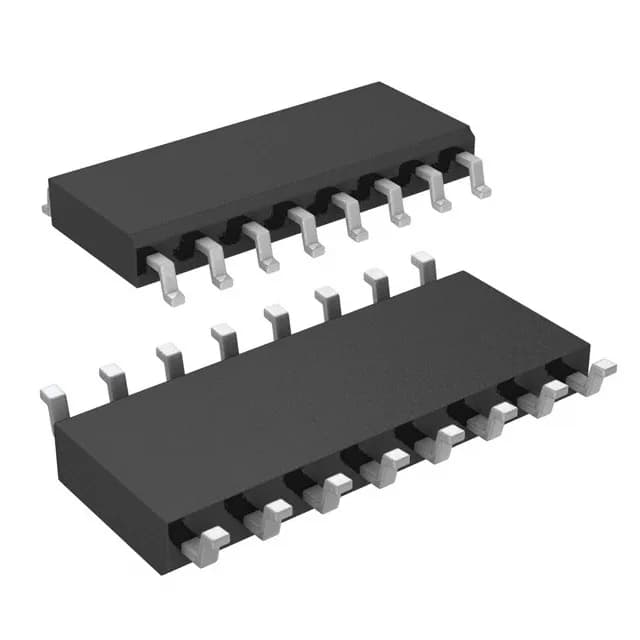
Analog Devices DG201ACSE+T — DC-DC Power Modules

DG201ACSE+T SPST-NC Analog Switch, 200 Ohm, 16-SOIC

MPNDG201ACSE+T
End of Life

Maxim Integrated DG201ACSE+T, quad SPST-NC analog switch, 200 Ohm max on-resistance, 600 ns / 450 ns switching, -90 dB crosstalk at 100 kHz, 16-SOIC, 0°C to 70°C, Tape & Reel / Cut Tape.

$6.66Ref. price · indicative, final on quote
Packaging16-SOIC (0.154", 3.90mm Width)
StockContact for availability
MOQ1 pcs
  • 100% new & originalTraceable channels only — no refurbs, no pulls, no remarked parts.
  • Date & lot codes on quoteStated per line before you commit; label photos on request.
  • MSL-compliant ESD packingMoisture-sealed bags with indicator cards; reels photo-verified.
  • PayPal buyer protectionPay by T/T, PayPal or Payoneer — card payments covered end to end.

Specifications

DG201ACSE+T Technical Specifications
ParameterValue
Mounting typeSurface Mount
Voltage - supply, dual (V±)±4.5V ~ 18V
Current - leakage (IS(off))5nA
Operating temperature0°C ~ 70°C (TA)
PackageTape & Reel (TR); Cut Tape (CT)
Crosstalk-90dB @ 100kHz
Case16-SOIC (0.154\", 3.90mm Width)
Switch circuitSPST - NC
Charge injection20pC
Number of circuits4
On-State resistance200Ohm
Switch time (Ton, toff)600ns, 450ns
Multiplexer (Demultiplexer circuit)1:1
Channel capacitance (CS(off), CD(off))5pF, 5pF

Product details

Quad SPST-NC analog switch — the crosstalk floor matters

The Maxim Integrated DG201ACSE+T is a quad single-pole single-throw normally-closed (SPST-NC) analog switch in a 16-SOIC package. It routes four independent signal channels with a multiplexer/demultiplexer circuit ratio of 1:1, meaning each switch is a simple pass-or-block element. The headline spec is the -90 dB crosstalk at 100 kHz — that figure tells you channel-to-channel bleed is low enough for precision analog multiplexing, audio routing, or data-acquisition front ends where a -80 dB floor would corrupt the measurement.

200 Ohm on-resistance — what it costs the signal

Max on-resistance of 200 Ohm sets the series impedance each channel adds to the signal path. In a unity-gain buffer or a low-impedance source, that 200 Ohm drops voltage and adds a pole with the load capacitance. For a 10 kOhm load the attenuation is about 2%, acceptable for most control and monitoring signals. The 5 pF channel capacitance (both CS(off) and CD(off)) combines with the 200 Ohm to give a roughly 1 MHz bandwidth corner — fine for audio and low-frequency analog, but not for video or fast ADC drive.

Switching speed and charge injection

Turn-on time is 600 ns max, turn-off 450 ns max. That asymmetry — faster off than on — is typical for a NC switch; the break-before-make timing matters if you are multiplexing sources into a single ADC input. The 20 pC charge injection is the glitch charge dumped onto the signal line when the switch changes state. In a 12-bit system with a 10 nF hold capacitor, 20 pC translates to about 2 mV of offset error per transition — something to budget for in sample-and-hold or integrator reset circuits.

Supply range and leakage

Dual-supply operation from ±4.5 V to ±18 V covers the common ±5 V, ±12 V, and ±15 V analog rails. The 5 nA max off-leakage (IS(off)) is low enough that it does not load precision references or high-impedance sensor outputs. Commercial temperature grade (0°C to 70°C) suits bench instrumentation, lab equipment, office electronics, and indoor industrial control panels — not extended or automotive environments.

Package and mounting

Surface-mount 16-SOIC with 0.154" body width (3.90 mm). The supplier device package is also 16-SOIC — no footprint mismatch between the generic case code and the specific part marking.

Lifecycle and sourcing posture

The DG201ACSE+T carries an active lifecycle status and is ROHS3 compliant. For BOM planning, the active status means no supply discontinuity risk from the manufacturer side.

Frequently asked questions

Is the DG201ACSE+T a direct replacement for the DG201ACSE (non-tape)?

Yes — the DG201ACSE+T is the same die and package as the DG201ACSE, differing only in the shipping medium. The +T suffix indicates Tape & Reel packaging; the non-T version ships in tubes. Electrical characteristics, pinout, and footprint are identical. If your BOM calls for the tube variant, the +T version is a drop-in substitute as long as your pick-and-place or rework process accepts Tape & Reel.

What is the difference between the DG201ACSE+T and the DG202ACSE+T?

The DG202ACSE+T is the normally-open (SPST-NO) counterpart to the DG201ACSE+T's normally-closed (SPST-NC) configuration. Both are quad switches with identical 200 Ohm on-resistance, 600 ns/450 ns switching, -90 dB crosstalk, and the same 16-SOIC package. The choice between them comes down to fail-safe state: the NC part passes signal with no control voltage applied; the NO part blocks signal until driven. They are not pin-compatible for a direct swap — the logic sense is inverted.

What is the crosstalk specification of the DG201ACSE+T?

The DG201ACSE+T is specified for -90 dB crosstalk at 100 kHz. This is the channel-to-channel isolation measured with a 100 kHz signal on the active channel and the off-channel leakage at the output. A -90 dB floor means less than 0.003% of the signal bleeds into adjacent channels — sufficient for 12-bit to 14-bit multiplexed systems where channel separation directly affects system accuracy.