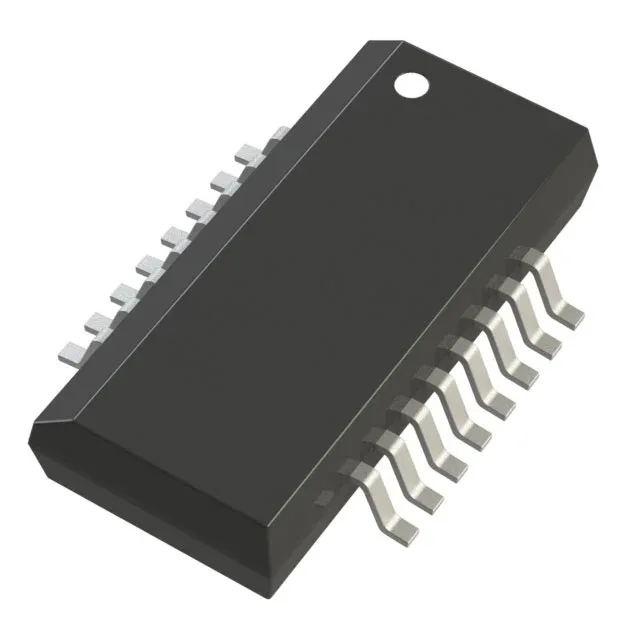
The ADUM7640ARQZ is a six-channel digital isolator from ADI's iCoupler family, using magnetic coupling to pass digital signals across a 1000 Vrms isolation barrier. All six channels are unidirectional and oriented the same direction — six inputs on side 1, zero on side 2 — so this part works as a pure buffer or level shifter from one domain to another, not a bidirectional transceiver. Data rate tops out at 1 Mbps, with typical rise/fall times of 2 ns and a maximum propagation delay of 75 ns each way. The package is a 20-lead SSOP (0.154" body width), also specified as the supplier device package 20-QSOP.
1 Mbps data rate — the bandwidth gate
The 1 Mbps data rate is the hard ceiling for this isolator. If your isolation channel carries SPI clocks above 1 MHz, CAN FD at 5 Mbps, or any serial link faster than a slow UART, this part won't close timing. The sibling ADUM7643CRQZ runs at 25 Mbps with a 3/3 input split, which opens up faster protocols but costs more per channel. For simple GPIO isolation, status signal crossing, or low-speed sensor readout at 1 Mbps or below, the ADUM7640ARQZ is the cost-effective pick.
ADI lists the ADUM7640ARQZ as Active. No last-time-buy clock ticking.
Common-mode transient immunity — why 15 kV/µs matters
In plain terms: when the ground on one side of the barrier jumps by thousands of volts in a microsecond — as it does in a motor drive IGBT switching event or a mains-fed SMPS — this isolator won't glitch or latch up. If your application has fast-switching power stages or long cables that pick up coupled noise, that CMTI rating is the spec that keeps the data clean. Designs with quiet, low-dV/dt environments can relax, but for industrial drives and inverters this is the number that matters.
No isolated power converter is integrated — you supply the secondary-side rail separately.