What this isolator does that a separate DC-DC + optocoupler can't
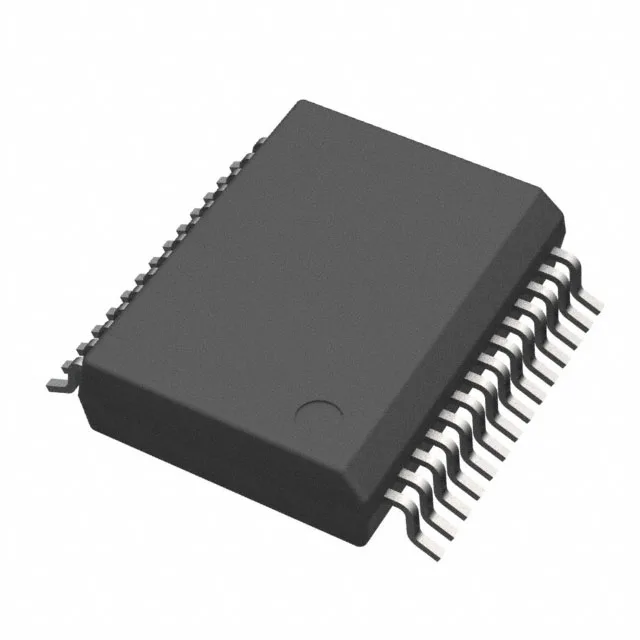
The ADUM6420ABRNZ5-RL is a 4-channel, unidirectional digital isolator from Analog Devices' IsoPower and iCoupler series. It integrates isolated power transfer into the same package as the signal isolation, meaning you get a 5000 Vrms reinforced isolation barrier and a 100 Mbps data path without needing a separate isolated DC-DC converter module on the secondary side. The magnetic coupling technology handles the isolation, and the IsoPower block generates the isolated-side supply rail internally. For a field swap or a BOM line that needs to shrink board area, this part collapses what used to be two or three components into one 28-SOIC-W-FP package.
5000 Vrms — what that buys you in the real world
A 5000 Vrms isolation rating is reinforced-grade for IEC 60747-17 and UL 1577. That covers motor-drive phase-to-ground isolation, medical patient-contact barrier (2 MOPP with creepage), and industrial fieldbus isolation where transient overvoltages hit several kilovolts. The 75 kV/µs common-mode transient immunity means this isolator won't glitch when a nearby IGBT switches 600 V in a few nanoseconds — a common failure mode with optocoupler-based designs. The 17 ns max propagation delay in each direction keeps timing closure tight for a 100 Mbps SPI clock or a CAN bus bit sample point.
Supply range and temperature — where it lives on the board
The 28-SOIC-W-FP package has a 7.50 mm body width and 0.295 inch pitch — a standard SOIC footprint that rework techs can hand-solder with a fine tip if the board layout gives access.
Unidirectional channels — what the 4/0 input-side count means
All four channels are unidirectional with all inputs on side 1 and all outputs on side 2. That is a deliberate topology for isolating a 4-bit parallel bus, a SPI bus (SCLK, MOSI, CS, and one extra), or four discrete control signals from a controller to a remote transceiver. If you need bidirectional isolation (e.g., for a half-duplex RS-485), you would need a different channel configuration or two devices. The 2.5 ns typical rise/fall time keeps signal integrity clean at 100 Mbps without excessive edge-rate ringing.