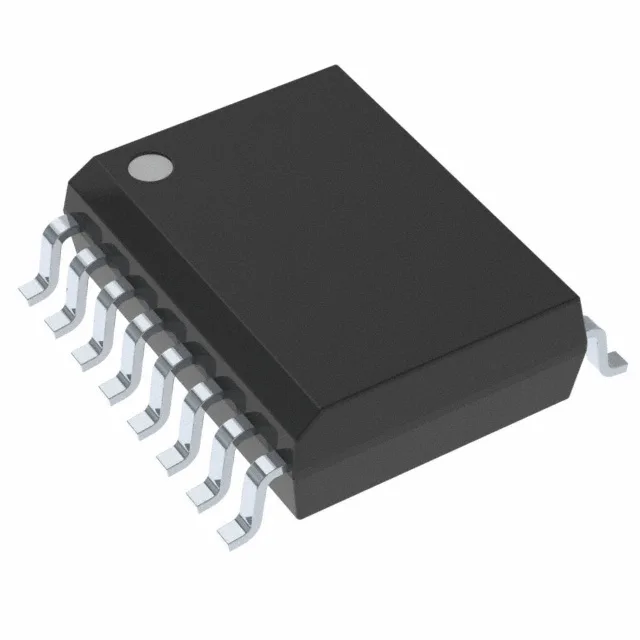
2500Vrms isolation with onboard dc-dc — one chip replaces two
The ADUM5402CRWZ-RL is a 4-channel digital isolator from the IsoPower and iCoupler series that integrates an isolated dc-dc converter on the same die. It delivers 2500Vrms galvanic isolation across a magnetic coupling barrier while supplying up to 150mW of regulated, isolated power to the secondary side — no separate isolated supply module needed. Data rate is rated at 25Mbps, with typical rise/fall times of 2.5ns and a maximum propagation delay of 60ns in either direction. Pulse-width distortion stays under 6ns, so the part handles SPI clock rates up to 25MHz without losing pulse symmetry. Common-mode transient immunity is specified at a minimum 25kV/µs, which is the figure that matters when the isolator sits between a noisy motor-drive inverter and a sensitive controller — the barrier won't glitch on fast voltage swings. Supply range spans 3V to 5.5V on both sides, so it can bridge a 3.3V MCU domain to a 5V sensor interface without a level shifter.
Package and footprint — 16-SOIC wide-body
Housed in a 16-SOIC wide-body package (7.50mm body width, 0.295" pitch), surface-mount only. The wide-body SOIC provides the creepage distance needed to maintain 2500Vrms isolation across the barrier in the PCB layout. No exposed thermal pad — the package is a standard SOIC-16W footprint, so layout reuse from other SOIC-16W isolators is straightforward.
The integrated isolated power is the single biggest BOM simplification. A typical isolated interface needs a separate dc-dc converter module plus a digital isolator — two parts, two footprints, two supply chains. The ADUM5402CRWZ-RL collapses that into one 16-SOIC package. The trade-off is that the onboard power is limited to roughly 150mW (enough to bias an isolated op-amp, a small ADC, or a few logic gates), so if the isolated side needs to drive a relay or a high-current sensor, you still need an external isolated supply. The 25Mbps data rate and 60ns propagation delay place this part in the mid-speed tier. It handles SPI, UART, and general-purpose GPIO isolation comfortably, but it won't keep up with gigabit Ethernet or high-speed parallel buses. For those, look at the iCoupler family with 100Mbps or 150Mbps ratings.