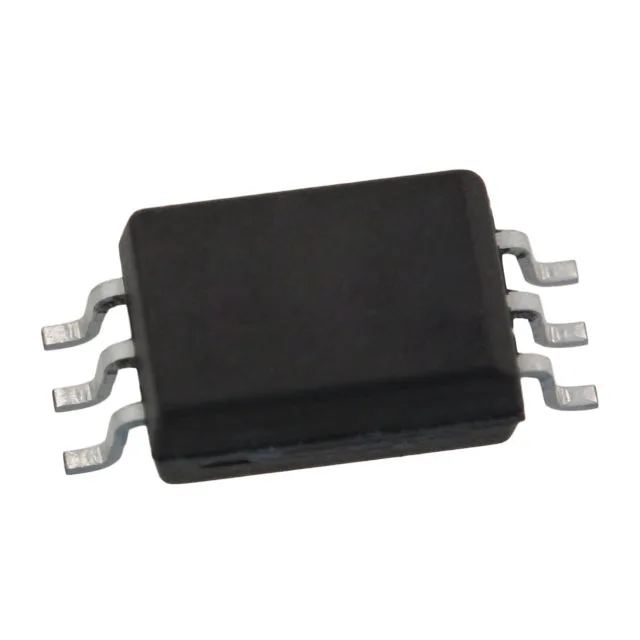
5000Vrms isolated gate driver for SiC and IGBT switching
The 18ns typical rise and fall time keeps switching losses in check for hard-switched topologies up to several hundred kHz. The wide-body 6-SOIC package (7.50mm width) provides the creepage distance needed to sustain the 5000Vrms isolation rating across the barrier.
The 2.3A peak output current determines the gate charge you can push in each switching cycle. For a typical IGBT with 100nC gate charge, the 18ns rise time translates to roughly 1.3A average during the Miller plateau — the ADUM4120ARIZ has headroom to drive that without stretching the switching edge. If the gate charge exceeds roughly 150nC at the same switching speed, the driver will current-limit and the switching loss climbs; that is the point to consider a higher-current driver or a separate booster stage. The output supply range of 4.5V to 35V covers both standard 12V and 15V gate drive rails and the higher 24V rails sometimes used for paralleled IGBT modules. The input side is powered from the logic-side supply, so the isolation barrier separates the low-voltage control domain from the high-side gate rail.
Propagation delay and pulse-width distortion
Maximum propagation delay is 69ns low-to-high and 79ns high-to-low, with a pulse-width distortion of 16.5ns max. For a 100kHz switching frequency with a 50% duty cycle, the 10ns asymmetry is a 0.1% duty-cycle error — negligible for most motor-drive and power-supply loops. But if you are paralleling multiple drivers for interleaved phases, the delay mismatch between channels adds up; the ADUM4120ARIZ's single-channel architecture avoids that by design — each phase gets its own driver with its own timing.
Active production, ROHS3, and approvals
Safety approvals from CSA, UR, and VDE are listed, which streamlines the certification process for end equipment that must meet IEC 60950 or IEC 62368 clearance and creepage requirements.