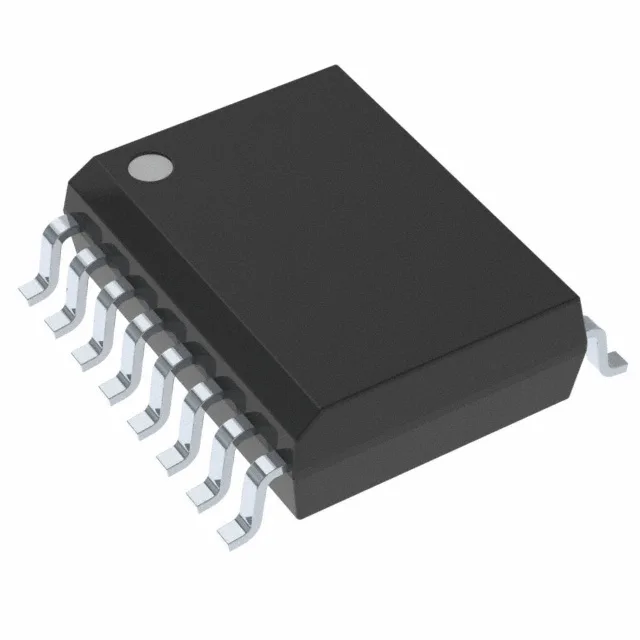
Analog Devices ADUM3400BRWZ — Digital Isolators

ADUM3400BRWZ iCoupler Digital Isolator, 10 Mbps, 2500 Vrms

MPNADUM3400BRWZ
End of Life

Analog Devices ADUM3400BRWZ iCoupler digital isolator, general purpose, 4-channel unidirectional, 10 Mbps data rate, 2500 Vrms isolation, 16-SOIC wide-body package, -40°C to 105°C.

$6.78Ref. price · indicative, final on quote
Packaging16-SOIC (0.295", 7.50mm Width)
StockContact for availability
MOQ1 pcs
  • 100% new & originalTraceable channels only — no refurbs, no pulls, no remarked parts.
  • Date & lot codes on quoteStated per line before you commit; label photos on request.
  • MSL-compliant ESD packingMoisture-sealed bags with indicator cards; reels photo-verified.
  • PayPal buyer protectionPay by T/T, PayPal or Payoneer — card payments covered end to end.

Specifications

ADUM3400BRWZ Technical Specifications
ParameterValue
TypeGeneral Purpose
SeriesiCoupler®
Channel typeUnidirectional
Mounting typeSurface Mount
Voltage3V ~ 5.5V
Voltage - isolation2500Vrms
Isolated powerNo
Operating temperature-40°C ~ 105°C
Pulse width distortion3ns
PackageTube
Data rate10Mbps
TechnologyMagnetic Coupling
Case16-SOIC (0.295\", 7.50mm Width)
Number of channels4
Inputs - side 1/Side 24/0
Rise (Fall time)2.5ns, 2.5ns
Propagation delay tpLH (tpHL)50ns, 50ns
Common mode transient immunity25kV/µs

Product details

Four-channel unidirectional isolation at 10 Mbps

All four channels are unidirectional and oriented with inputs on side 1, making it a straightforward fit for isolating a 4-bit parallel bus or four independent digital signals where the data flows in one direction. The 10 Mbps data rate covers common interfaces like SPI (up to 10 MHz clock), UART, and general-purpose GPIO isolation without stretching the timing budget.

25 kV/µs transient immunity — keeps data clean in noisy environments

A minimum common-mode transient immunity of 25 kV/µs means the ADUM3400BRWZ can reject fast voltage spikes between its ground domains — the kind of noise you get from a switching MOSFET in a motor drive, an inverter leg, or a flyback converter. If the isolation barrier sees a 25 kV/µs or slower common-mode step, the output stays valid. That spec is the difference between a clean data stream and bit errors on the factory floor.

Propagation delay and pulse-width distortion

Maximum propagation delay is 50 ns in either direction, and pulse-width distortion is held to 3 ns max. For a 10 Mbps signal with a 100 ns bit period, 50 ns of delay is half a bit time — enough to matter if you are daisy-chaining multiple isolators in a timing-critical path. The 3 ns pulse-width distortion means the on and off delays are closely matched, so duty cycle is preserved within a few percent at 10 Mbps. Rise and fall times are a typical 2.5 ns, keeping the edges sharp enough for clean clock recovery.

The wide-body SOIC-16 package provides the creepage distance needed to maintain 2500 Vrms isolation in high-humidity or polluted conditions.

Active production and compliance

No lead-free exemption issues to track for a long-life BOM.

Frequently asked questions

What is the data rate of ADUM3400BRWZ?

The ADUM3400BRWZ supports a data rate of 10 Mbps, which is sufficient for isolating SPI at up to 10 MHz, UART at standard baud rates, and general-purpose digital signals.

Is ADUM3400BRWZ RoHS compliant or lead-free?

Yes, the ADUM3400BRWZ is ROHS3 compliant, meaning it meets the current RoHS directive without any exempted lead content.

Can ADUM3400BRWZ be used for I2C isolation?

The ADUM3400BRWZ has four unidirectional channels, all with inputs on side 1. I2C is a bidirectional bus requiring a bidirectional isolator or a unidirectional part with external circuitry to handle the data direction reversal. This part is not a direct fit for standard I2C isolation without additional logic.

What is the difference between ADUM3400BRWZ and ADUM3401BRWZ?

The ADUM3400BRWZ has all four channels oriented with inputs on side 1 (4/0 configuration). The ADUM3401BRWZ has three inputs on side 1 and one input on side 2 (3/1 configuration), allowing one channel to carry data in the reverse direction. The channel direction arrangement is the only difference; all other specifications including data rate, isolation, and package are identical.