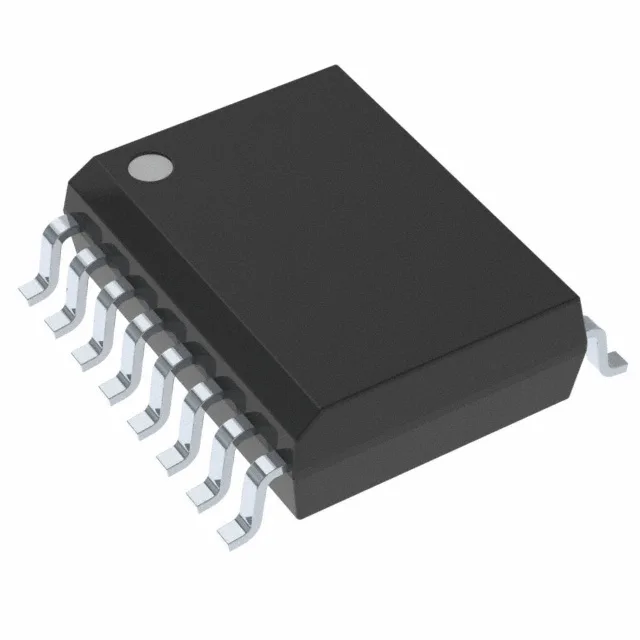
5000Vrms isolation in a 16-SOIC wide-body — what it buys you
The ADUM2402ARWZ-RL is a four-channel, unidirectional digital isolator from the iCoupler magnetic-coupling family. Its headline rating is 5000Vrms isolation in a 16-SOIC wide-body package — a reinforced insulation class that suits medical patient-contact interfaces, industrial motor-drive feedback paths, and grid-tied power converters where the isolation barrier must survive transient overvoltages without breakdown. The 1Mbps data rate is deliberate: this is the throughput tier for isolated UART, I²C, or slow SPI buses, not high-speed isolated Ethernet or USB. If your design needs 10Mbps or faster, you are looking at a different iCoupler variant (ADUM140x series with higher speed grades).
Channel count and direction — 2/2 split for unidirectional isolation
Four unidirectional channels split 2/2 across the isolation barrier (two from Side 1 to Side 2, two from Side 2 to Side 1). This fixed direction matters: unlike the ADUM2400 series (all same-direction), the ADUM2402 lets you isolate a bidirectional data bus without external direction-control logic. The 2.7V to 5.5V supply range on both sides means the part works in mixed-voltage domains — a 3.3V MCU talking to a 5V sensor, for example — without a separate level shifter.
Timing margins for the bus
Propagation delay is 100ns max (both directions), with pulse-width distortion capped at 40ns. At 1Mbps (1µs bit period), the 100ns delay consumes 10% of the bit time — acceptable for most UART and I²C links, but tight for a daisy-chained SPI bus with multiple isolators in series. The 2.5ns rise/fall times are fast enough to avoid slew-rate limiting at 1Mbps, but the 25kV/µs common-mode transient immunity (minimum) is the spec that matters for motor-drive or inverter environments where high dV/dt on the ground plane can couple through the barrier. If your system sees >25kV/µs common-mode edges, you need a reinforced or capacitive-coupling isolator rated higher.
For a production BOM, this is the low-risk choice — you are not chasing surplus lots or date-code windows.