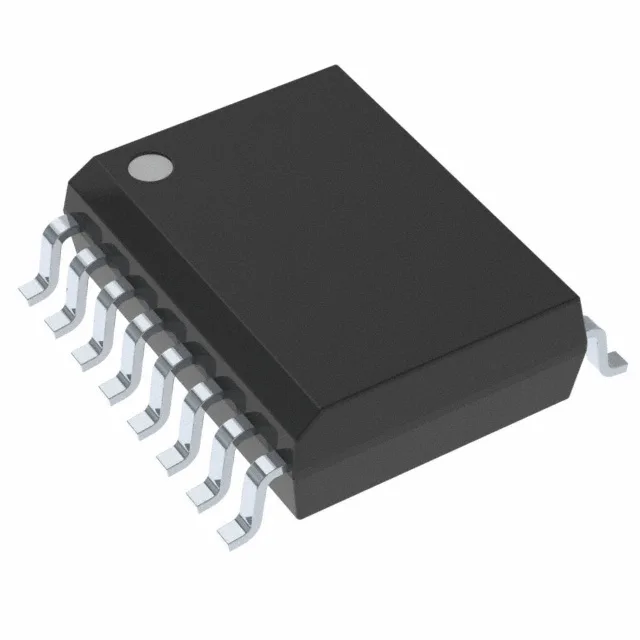
Three channels, one direction — what the 3/0 input count means for your bus
The ADUM230D1BRWZ is a 3-channel unidirectional digital isolator from Analog Devices' iCoupler family, built on magnetic coupling technology. It provides 5000 Vrms of galvanic isolation across a 16-SOIC package, with all three channels configured as inputs on Side 1 and outputs on Side 2 — the 3/0 input count means no reverse-direction channel is available, so this part is a straight-through isolator for signals flowing from one domain to the other. The 150 Mbps data rate supports high-speed interfaces like SPI, UART, and general-purpose digital I/O without adding timing margin headaches.
150 Mbps and 13 ns propagation delay — timing budget for the isolation barrier
The 2.5 ns typical rise/fall time keeps signal edges clean enough for 150 Mbps NRZ data, but the unidirectional channel layout means you need a separate part if your bus requires bidirectional handshaking. For SPI isolation, the three channels cover SCK, MOSI, and CS — MISO would need a second device or a bidirectional isolator.
75 kV/µs CMTI — why it matters for motor drives and inverters
The minimum common-mode transient immunity of 75 kV/µs is the spec that separates this part from slower, lower-CMTI isolators. In a variable-frequency motor drive or a switched-mode power supply, the high-side floating node can slew hundreds of volts in nanoseconds. If the isolator cannot reject that transient, data errors appear on the low-voltage side. This rating means the ADUM230D1BRWZ is sized for industrial inverter and servo-drive environments where common-mode dv/dt exceeds 50 kV/µs.
Both sides must be powered — there is no isolated power output (the Isolated Power field is No), so you still need a separate DC-DC converter to create the isolated secondary-side rail.