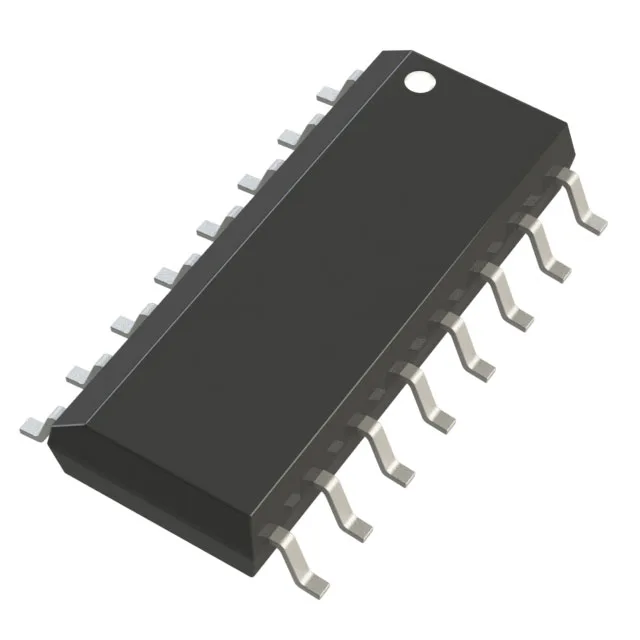
Six-channel digital isolator — 150 Mbps, 3000 Vrms, SOIC-16
It delivers 150 Mbps per channel with a 3000 Vrms isolation barrier, 75 kV/µs common-mode transient immunity, and 13 ns max propagation delay. Housed in a 16-pin SOIC (3.90 mm width), it is aimed at industrial fieldbus isolation, motor-drive interface, medical equipment isolation barriers, and any application where galvanic separation with high-speed data throughput is required.
At 150 Mbps, this isolator can pass SPI clock rates up to 75 MHz (DDR) or 150 MHz (SDR), full-speed USB 2.0 (480 Mbps is out of reach — this is not a USB isolator), and most industrial Ethernet PHY signals below 100 Mbps. The 13 ns max propagation delay (tpLH / tpHL) and 4.5 ns max pulse-width distortion keep the eye open for synchronous interfaces; you will not lose setup/hold margin on a 50 MHz SPI bus. The 2.5 ns typical rise/fall time means the signal edges are fast enough to cause ringing if the PCB trace is long — keep the stub short or add a series resistor near the output.
3000 Vrms isolation and 75 kV/µs CMTI — the safety and noise spec
The 3000 Vrms isolation rating is a 1-minute withstand test per UL 1577. For reinforced or double-insulation applications (medical, motor drives), check the system-level creepage and clearance requirements — the SOIC-16 body gives about 7.5 mm creepage minimum, which covers basic isolation up to 300 Vrms working voltage per IEC 60950-1. If your application sees >75 kV/µs (GaN half-bridge at 100+ V/ns), step up to the ADuM family with higher CMTI.
Channel count and direction — 4/2 split
Six channels total: four on side 1 (input), two on side 2 (input). That is a 4/2 unidirectional split, meaning four channels go from side 1 to side 2, two channels go from side 2 to side 1. This suits a typical SPI-plus-control-signal isolation pattern: SCK, MOSI, CS, and one handshake going forward; MISO and one handshake returning. If you need a different direction count (e.g., 3/3 or 5/1), look at the ADuM160N or ADuM161N variants in the same family — pin-compatible in the same SOIC-16 footprint.
No separate VIO pin — each side has its own VDD and GND. The unidirectional architecture means the input side drives the output side; the output side does not need to power the input. This is a straight drop for 3.3 V to 5 V level translation or 1.8 V to 3.3 V. The wide supply range also helps during power sequencing: if one side ramps before the other, the outputs remain in a safe state (default low) until both sides are powered.
Temperature grade — industrial full range
This includes outdoor telecom cabinets, engine-bay electronics, and factory-floor PLCs. The 125 °C upper limit is junction temperature, not ambient — derate power dissipation if the ambient exceeds 105 °C. In a typical 25 °C ambient with 150 Mbps switching on all six channels, self-heating adds about 15-20 °C above ambient, so the junction stays well within the limit.
ROHS3 compliant (lead-free, no exemptions). For dual-sourcing resilience, the ADuM160N (same package, 6-channel, 150 Mbps, 3000 Vrms) is a pin-compatible alternative with a 3/3 direction split — verify your required channel direction before substituting.