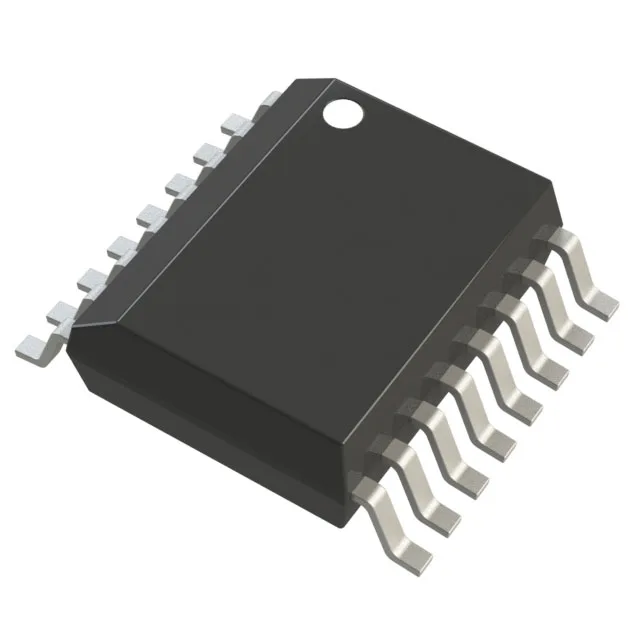
What this 4-channel iCoupler does on your board
The ADUM1447ARQZ is a 4-channel, unidirectional digital isolator from Analog Devices' iCoupler family, built around magnetic coupling technology rather than the older optocoupler approach. It gives you four independent isolation channels in a 16-QSOP package, with two channels going each direction (Side 1/Side 2: 2/2). The part runs from a 2.25V to 3.6V supply on both sides, which means it plays nicely with 3.3V and 2.5V logic families without extra level shifting. That CMTI number is the one that matters when you're shoving this between a noisy power stage and a sensitive controller — it tells you the isolator won't glitch when the ground plane jumps several hundred volts in a microsecond. Data rate is 2Mbps, with propagation delay max of 180ns in either direction and pulse-width distortion held to 8ns max. Rise and fall times are a crisp 2ns typical.
2Mbps data rate — what it buys you and where it won't go
At 2Mbps, this isolator handles SPI at moderate clock rates, UART communication up to 115200 baud with margin, and general-purpose GPIO isolation for status signals, fault flags, and enable lines. It will not carry high-speed SPI at 10MHz+ or full-speed USB — for those you'd step up to the ADuM1400 series or the ADuM3160 USB isolator. The 180ns propagation delay means you lose about a third of a microsecond per crossing, which is fine for control loops running at a few kilohertz but starts eating into timing margin if you're trying to close a fast current loop over the isolation barrier.
That means no last-time-buy notice looming, no end-of-life clock ticking. It is also ROHS3 compliant, so no conflict with EU or California regulatory requirements.
Package reality — 16-QSOP with 0.154" body width
The device comes in a 16-QSOP package (also listed as 16-SSOP with 0.154" body width, 3.90mm width). It is a surface-mount part with a 1.27mm pitch — standard SOIC footprint territory, nothing exotic. No exposed thermal pad to worry about, no special soldering profile beyond the usual MSL precautions. The 2.25V to 3.6V supply range on both sides is narrow enough that you want clean rails; a 3.3V rail with 5% tolerance keeps you well inside the window.