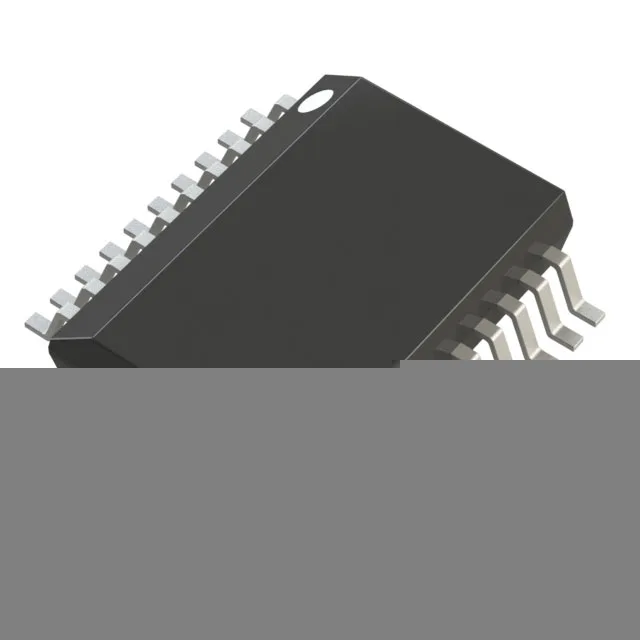
Four-channel digital isolator with 3750 Vrms reinforced isolation
The ADUM1441ARSZ-RL7 is a 4-channel digital isolator from Analog Devices' iCoupler series, using magnetic coupling to transfer digital signals across a 3750 Vrms isolation barrier. It is a general-purpose part, not a dedicated interface isolator, so it fits wherever you need to break ground loops or provide safety isolation on logic-level signals — SPI, UART, GPIO, or low-speed serial links. Three channels are oriented from Side 1 to Side 2, and one channel runs the opposite direction (3/1 split). That asymmetry matters when your application has a dominant data flow from one domain — for example, an MCU on the low-voltage side sending control signals to a gate driver on the high-voltage side, with a single fault-status line returning.
2 Mbps data rate and 180 ns propagation delay — what they mean on the bus
The 2 Mbps data rate is the raw throughput ceiling per channel. For a 1 MHz SPI clock or a 115.2 kbps UART, that is plenty of margin. The 180 ns max propagation delay is the one-way latency through the isolator — budget that into your timing closure if you are running a daisy-chained SPI bus or a time-critical enable signal. The 8 ns max pulse-width distortion means the part preserves duty cycle within a tight window, which helps avoid bit errors on edge-triggered protocols. Rise and fall times are 2 ns typical, which keeps the signal edges clean without excessive ringing — but that also means the output slew rate is fast enough to couple noise into adjacent traces if the layout is sloppy. Keep the isolation barrier gap clear of copper pour, and route the output traces away from the input side.
The 25 kV/µs minimum common-mode transient immunity is the rating that determines whether the isolator holds its output state when a high-voltage switching event slams the barrier with a fast dV/dt. In a motor-drive inverter, a 600 V bus switching at 20 kHz can generate transients that exceed 10 kV/µs. This part's 25 kV/µs rating gives a comfortable margin for industrial drives, solar inverters, and UPS systems. If your application involves SiC or GaN switching stages with sub-10 ns rise times, check that the transient amplitude stays within the 3750 Vrms isolation rating.
The supply voltage range of 2.25 V to 3.6 V covers 3.3 V and 2.5 V rails directly. No separate regulator needed if your system already runs one of those. The wide temp range also helps in sealed enclosures where self-heating raises the ambient.