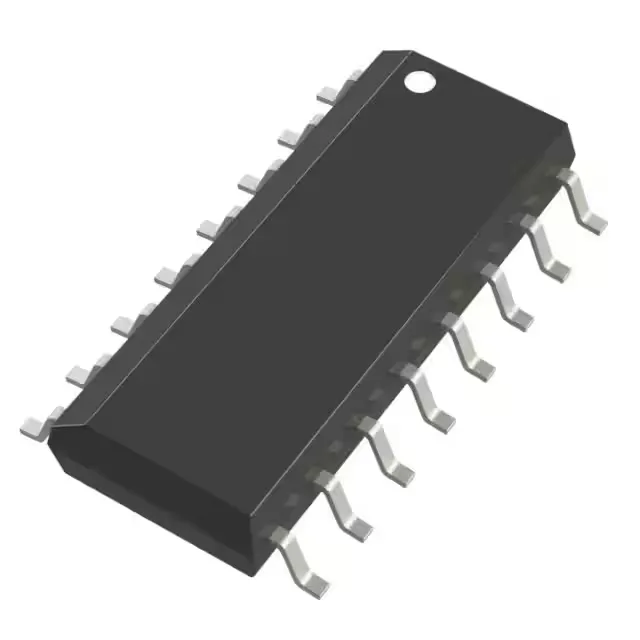
The ADUM131D1BRZ is a 3-channel, unidirectional digital isolator from the iCoupler series, using magnetic coupling to transfer digital signals across a 3000 Vrms isolation barrier. With a 75 kV/µs minimum common-mode transient immunity, it is built for environments with fast voltage transients, such as motor drives, inverters, and industrial fieldbus nodes.
150 Mbps data rate and 3 ns pulse-width distortion — what they mean for signal integrity
The 150 Mbps data rate supports most common serial protocols without stretching the timing budget. The 3 ns max pulse-width distortion means the output pulse width stays close to the input width, which matters for protocols like CAN or RS-485 where duty-cycle symmetry affects bit timing. The 13 ns max propagation delay (same for low-to-high and high-to-low) is symmetrical, so the part does not introduce a duty-cycle skew on its own. For a 50 MHz SPI clock, the 13 ns delay plus 2.5 ns rise/fall eats about 1.5 of the 20 ns period — still workable, but budget the remaining margin for PCB trace and load capacitance.
75 kV/µs CMTI — why it matters for motor-drive and inverter designs
Common-mode transient immunity of 75 kV/µs (minimum) is the spec that keeps the output from glitching when a fast voltage transient slams across the isolation barrier. In a motor-drive application, the IGBT switching node can swing hundreds of volts in tens of nanoseconds, coupling a large dV/dt through the parasitic capacitance of the isolator. A part with lower CMTI would latch or toggle the output, causing spurious data. The ADUM131D1BRZ's 75 kV/µs rating handles that transient without corrupting the signal, so it is a good fit for gate-driver feedback, encoder interfaces, and isolated ADC reads in variable-frequency drives.
The 16-SOIC narrow-body package (3.90 mm width) is a common footprint, so layout reuse across designs is straightforward.