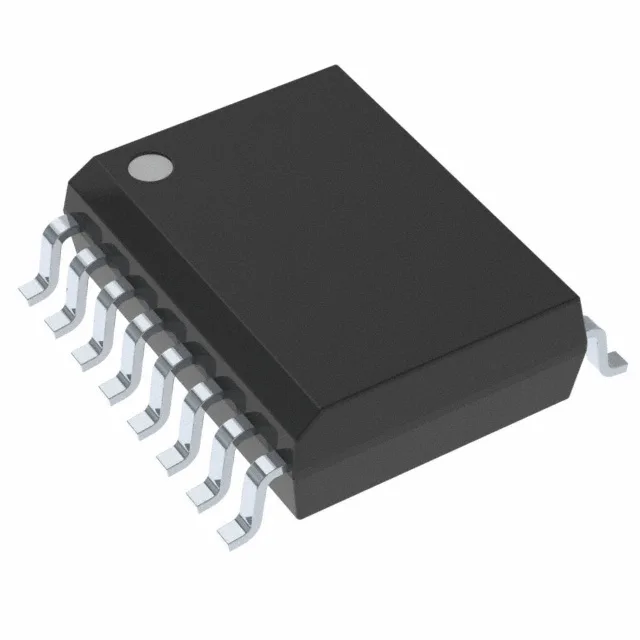
Three-channel unidirectional isolator for industrial signal paths
The ADUM1311ARWZ-RL is a three-channel digital isolator from Analog Devices' iCoupler series, built on magnetic coupling technology rather than the older optocoupler approach. It provides 3750Vrms isolation between two power domains, with two channels passing data from Side 1 to Side 2 and one channel going the opposite direction — a 2/1 input split that suits applications like isolated SPI where you need separate lines for clock, data-in, and data-out.
The 3750Vrms isolation rating is the standard for reinforced insulation in 240VAC mains-connected equipment — it passes the 60-second hipot test required for safety certifications like IEC 60950-1. For the procurement side, this means the part can be specified in power supplies, inverters, and medical devices without needing a higher-rated (and more expensive) isolator. In a motor drive with SiC or GaN FETs switching at 50 kHz, fast voltage transients across the isolation barrier can couple through parasitic capacitance and corrupt data. This part's CMTI rating keeps the output state valid through those edges — a key differentiator from older optocouplers that typically struggle above 10kV/µs.
Supply rails and channel direction — layout decisions
Each side of the isolator has its own supply pin (VDD1 and VDD2), each accepting 2.7V to 5.5V independently. There is no integrated isolated DC-DC converter, so both sides need external power — a separate isolated supply or an external isolator module if the system does not already have isolated rails. The channel direction is fixed: Side 1 has two inputs (channels A and B), Side 2 has one input (channel C). This is a unidirectional device — data flows only in the assigned direction. For bidirectional buses like I2C, you would need two channels (one each way) or an external direction-control circuit.