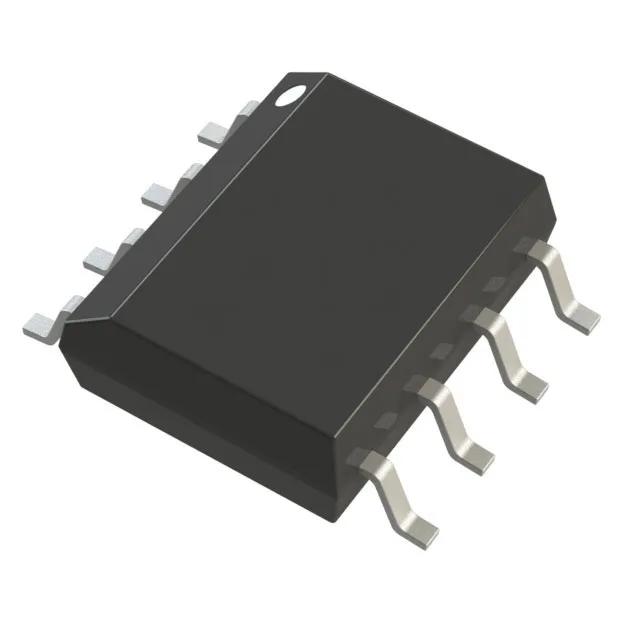
The ADUM1281BRZ is a two-channel, unidirectional digital isolator from Analog Devices' iCoupler family, built around magnetic coupling rather than optocouplers. It provides 3000Vrms galvanic isolation between a single input on side 1 and a single output on side 2, with a second channel in the same direction — so it handles two independent signals crossing the isolation barrier, like a SPI clock and data line, or a pair of GPIOs. The 25Mbps data rate keeps up with most industrial UARTs, CAN transceivers, and moderate-speed SPI buses. Supply range from 3V to 5.5V means it works on both 3.3V and 5V domains without a separate rail translator.
3000Vrms isolation — what it means in the field
3000Vrms is the rated isolation voltage for one minute per the standard. That's enough for basic reinforced insulation in mains-connected equipment up to 300V AC working voltage, or functional isolation in higher-voltage systems. If you're swapping this into a motor-drive or SMPS feedback path, the 3000Vrms rating covers the transient spikes you'd see on a 230V line. The common-mode transient immunity of 25kV/µs means it won't glitch when a nearby relay or IGBT switches — a real concern in noisy industrial cabinets.
Timing specs that matter for bus margin
Propagation delay is 35ns max in either direction, and pulse-width distortion is held to 3ns max. That's tight enough for 25Mbps signaling with a 40ns bit period — you still have a few nanoseconds of margin for PCB trace skew. Rise and fall times are 2.5ns typical, which keeps the edges clean without excessive ringing if you keep the trace length under a few inches. If your system runs at 10Mbps or slower, the 35ns delay is negligible; at 25Mbps you'll want to account for it in the timing budget, especially if the isolator sits in a feedback loop.
The magnetic coupling technology doesn't suffer the LED aging that optocouplers do, which is a plus for long-life industrial or infrastructure equipment. No isolated power output on this variant — it's a pure signal isolator, so you still need a separate DC-DC converter if the secondary side needs its own supply.