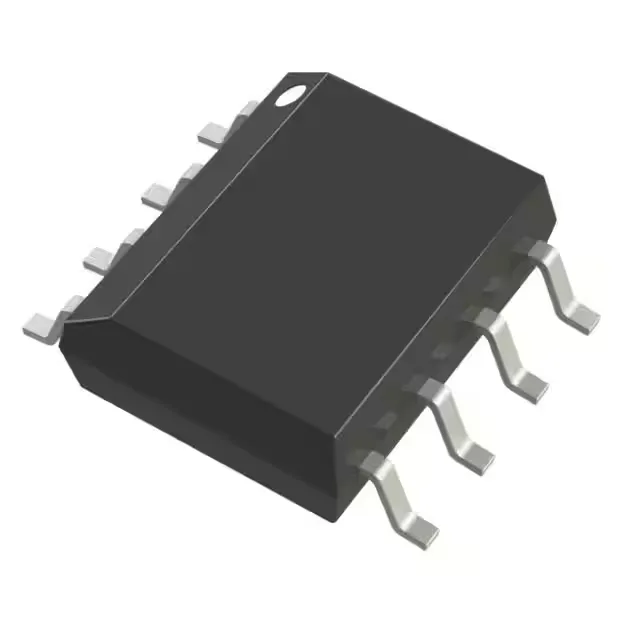
The ADI ADUM1240ARZ is a two-channel digital isolator from the iCoupler family, using magnetic coupling to pass signals across a 3000 Vrms isolation barrier. It provides two unidirectional channels (both inputs on side 1, no outputs on side 2 reversed), running at 2 Mbps with 180 ns propagation delay. The 25 kV/µs common-mode transient immunity makes it a solid choice for motor-drive or inverter interfaces where fast-switching nodes try to jump the gap. Supply range from 2.25 V to 3.6 V lets it sit on a 3.3 V or 2.5 V rail without a secondary regulator.
2 Mbps data rate and 180 ns propagation delay — timing budget for isolated SPI/UART
At 2 Mbps, this part handles isolated SPI at up to 2 MHz clock, or a UART at 115200 baud with margin to spare. The 180 ns max propagation delay (both directions) is the number to budget in your timing closure — it adds about one-third of a bit time at 2 Mbps, so a full-duplex SPI loop through two isolators (TX and RX) sees 360 ns round-trip latency. Pulse-width distortion is held to 8 ns max, which keeps the duty cycle within spec for most PWM or timer signals. The rise/fall times are 2 ns typical, so the signal edges are clean enough for 3.3 V logic without external schmitt triggers.
Package and reflow — SOIC-8, MSL, and what the pick-and-place needs to know
That's a standard footprint — no exotic pitch or exposed pad to fight. The part ships in Tube, so if your line runs tape-and-reel only, plan for a tube-to-reel transfer or order the tape-and-reel variant (ADUM1240ARZ-RL7). MSL is not explicitly stated in the listing, but iCoupler parts in SOIC-8 typically carry MSL 1 or 2; still, if the moisture-barrier bag has been open past the floor-life window, bake before reflow — popcorning a $3 isolator on a $200 board is a bad day.
The iCoupler series has a long production history and no PCN activity flagged for this order code. For dual-sourcing or a higher-isolation alternative, the ADUM1245ARSZ offers 3750 Vrms in the same pinout and data rate, though in a different package (8-SOIC with wider creepage).