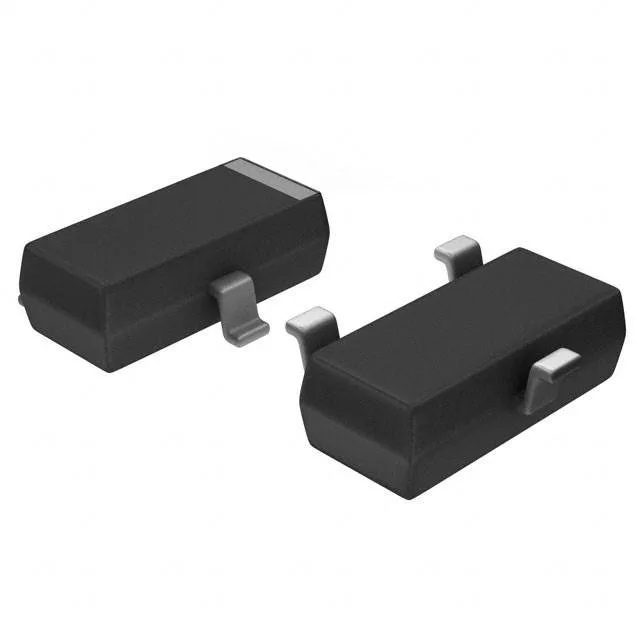
The ADR5043ARTZ-REEL7 is a 3.0 V fixed-output shunt voltage reference from the ADR504 series, in a SOT-23-3 package. It is a three-terminal device that regulates the voltage across itself by shunting current to ground, requiring only a single external resistor to set the bias current. The ±0.2% initial tolerance and 100 ppm/°C temperature coefficient mean this part holds the 3.0 V rail within about 6 mV at 25 °C and drifts roughly 0.3 mV over a 100 °C swing — tight enough for a 12-bit ADC reference or a comparator threshold where a few millivolts of uncertainty matter. The 15 mA maximum output current and 60 µA minimum cathode current define the operating window: the external resistor must be sized so the total current (load plus reference) stays between 60 µA and 15 mA over all conditions. This is a shunt topology, so it works like a programmable Zener — the load sees a regulated voltage, but the supply current varies with the input voltage and the resistor value, which is different from a series reference.
Sizing the bias resistor — the one calculation that matters
For a shunt reference, the external resistor from the supply to the cathode pin sets the bias current. The resistor value must keep the cathode current between 60 µA and 15 mA, including the load current.
The ADR5043ARTZ-REEL7 specifies 4.3 µVrms noise from 0.1 Hz to 10 Hz and 180 µVrms from 10 Hz to 10 kHz. The low-frequency noise is the figure that matters for a precision ADC reference or a low-drift comparator — it sets the floor for the signal-to-noise ratio at DC and near-DC. The 10 Hz to 10 kHz noise is higher but can be filtered with a small capacitor across the reference output if the application is sensitive to wideband noise. For a 3.0 V reference, 4.3 µVrms is about 1.4 ppm of the output voltage — clean enough that the reference is not the dominant noise source in most 12-bit or even 16-bit systems.