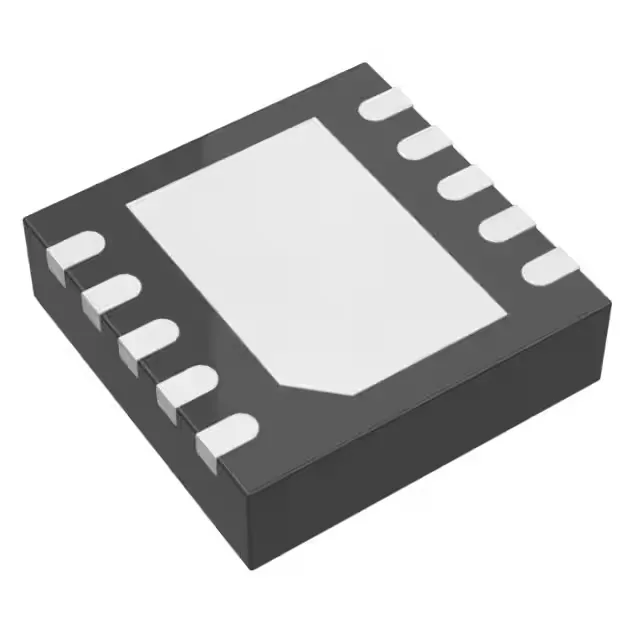
The Analog Devices ADP5304ACPZ-1-R7 is a step-down (buck) switching regulator delivering a programmable output at up to 50 mA from a 2.15 V to 6.5 V input rail. It integrates a synchronous rectifier, which keeps efficiency high at light loads — a key advantage for battery-powered or always-on rails where every milliwatt matters.
50 mA output — the design constraint
At 50 mA maximum output, this regulator is sized for low-power auxiliary rails — think always-on microcontroller standby supply, CAN transceiver bias, or a sensor front-end. It is not a main-rail converter for a motor drive or a high-current FPGA core. If your BOM needs more than 50 mA, the ADP5302 family (same pinout, same 2 MHz switching, same package) offers a higher current rating while keeping the same footprint and control loop characteristics.
Synchronous rectification and light-load efficiency
The integrated synchronous rectifier replaces the usual Schottky catch diode with a low-Rds(on) FET. At 50 mA output, that saves several hundred milliwatts of diode conduction loss compared to an asynchronous design. For a device that spends most of its life in a few-milliamp sleep state, that efficiency gain directly extends battery life or reduces thermal buildup in a sealed enclosure.
For dual-sourcing or a higher-current option, the ADP5302ACPZ-2-R7 shares the same package and switching frequency, though its output current rating differs — verify the fit against your load budget before substituting.