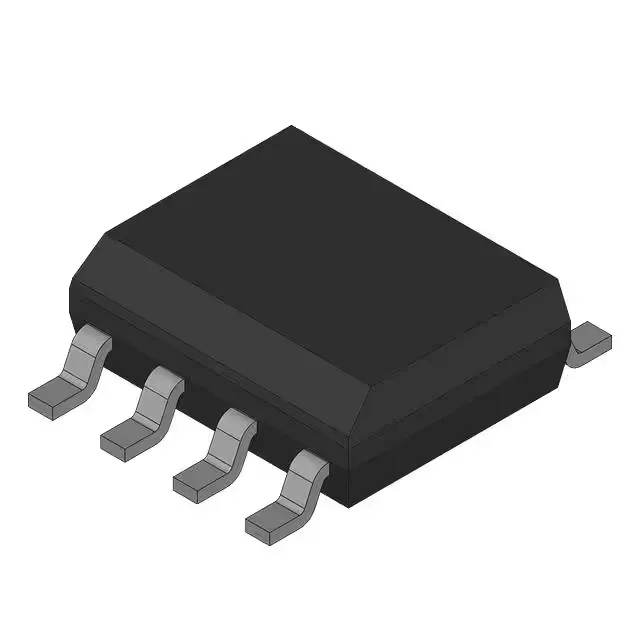
What this dual bootstrapped driver is for
The ADP3118JRZ-RL is a dual, bootstrapped, 12V-rated MOSFET driver from Analog Devices, designed to drive two N-channel MOSFETs in a half-bridge configuration. It is the gate-drive engine for synchronous buck converters, VRM modules, and any point-of-load regulator where the high-side FET needs a bootstrap rail above the input supply. Each of the two drivers is non-inverting, so the PWM input logic directly controls the gate state — no inversion stage needed between the controller and the FETs. The logic thresholds are set at 0.8V (VIL) and 2V (VIH), compatible with 3.3V and 5V PWM controllers without level shifting.
Supply range and bootstrap headroom
The supply voltage range of 4.15V to 13.2V covers 5V and 12V rails directly, plus intermediate bus voltages. The high-side bootstrap pin is rated to 25V maximum — that gives 12V of headroom above a 13.2V supply, enough to fully enhance the high-side N-channel FET even at the top of the supply range. If your design runs a 12V rail and the bootstrap cap charges to VCC minus a diode drop, the 25V rating leaves margin. Stay below 25V on the bootstrap pin — exceeding it risks gate oxide rupture on the high-side FET.
Switching speed and thermal envelope
Typical rise time is 25ns and fall time 20ns into a capacitive load — fast enough for 300-500 kHz switching without excessive cross-conduction, but not so aggressive that the PCB layout becomes a microwave problem. The 8-SOIC package (0.154" width, 3.90mm) is a standard footprint. For high-frequency or high-current designs, a 4-layer board with thermal vias under the driver is recommended.
Closest functional peer: ADP3415LRM-REEL7
The ADP3415LRM-REEL7 shares the same gate type (N-channel MOSFET), input type (non-inverting), channel type (synchronous), and driver count (2). The key differences are supply voltage (fixed 7V vs 4.15-13.2V), rise/fall time (20ns/20ns vs 25ns/20ns), and operating temperature (0°C to 100°C ambient vs 0°C to 150°C junction). The ADP3118JRZ-RL wins on supply flexibility and high-temperature capability; the ADP3415 is a drop-in for fixed 7V rails with a lower thermal ceiling.