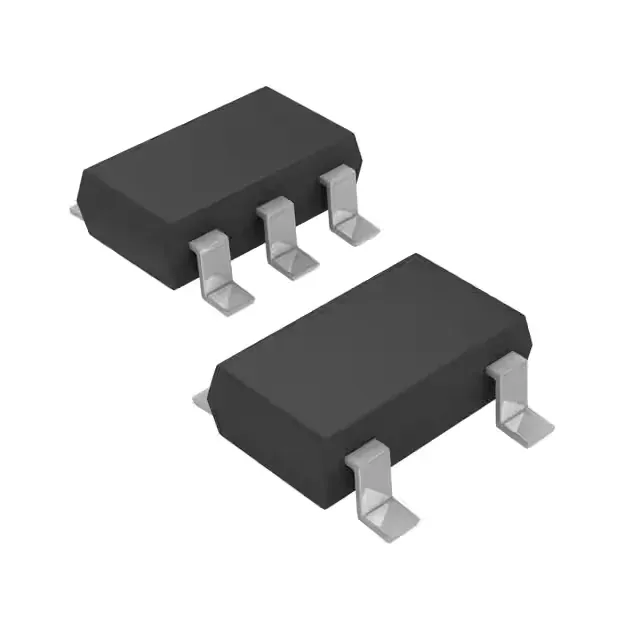
3.3 V rail, 150 mA, 1.25 µA standby — the LDO for always-on analog supplies
The ADP160AUJZ-3.3-R7 is a fixed 3.3 V output LDO from Analog Devices' ADP160 series, rated for 150 mA continuous output. Its headline draw is 1.25 µA quiescent current — that is the standby floor for a battery-powered sensor node that stays awake on a threshold interrupt and sleeps the rest of the time. The 225 mV maximum dropout at full load tells you the input rail must stay above 3.525 V across the load range to hold regulation. That is a straightforward budget for a 3.6 V Li-ion cell or a 5 V bus with a diode drop. An engine-bay ECU or an outdoor IoT gateway that sees 105°C on the PCB still has margin.
PSRR envelope — where the noise rejection drops off
Power supply rejection ratio is specified at 60 dB typical at 100 Hz, rolling to 50 dB at 1 kHz. That means at 100 Hz the output ripple is attenuated by a factor of 1000; at 1 kHz it is still 316×. For an analog front-end powered from a switching regulator, this LDO cleans the rail across the audio band and into the lower switching harmonics. Above 1 kHz the PSRR continues to roll off — upstream filter capacitance ahead of the LDO is the standard mitigation if the switching noise sits above 100 kHz.
TSOT-23-5 footprint and sourcing posture
The part is supplied in a TSOT-23-5 package — a 5-lead thin SOT-23, roughly 2.9 mm × 2.8 mm. The closest parametric peer is the ADP162AUJZ-3.3-R7: same 3.3 V output, same 150 mA, same TSOT-23-5 package, same PSRR curve. The ADP160 draws lower quiescent current (1.25 µA vs the ADP162's typical figure), which is the deciding factor for a battery-powered design. ROHS3 compliant.