The ADP160ACBZ-1.2-R7: ROHS3 compliant per the manufacturer's declaration, which simplifies compliance documentation for EU and global markets.
150 mA fixed 1.2 V rail — where the spec matters
Single-output LDO delivering 150 mA at a fixed 1.2 V — the output is set internally, so no external resistor divider is needed, saving board area and one BOM line. Quiescent current is 1.25 µA typical — this keeps the regulator's own draw negligible in battery-powered always-on domains, where every microamp extends sleep life. Maximum supply current is 65 µA, so even under light load the overhead stays well below 0.1 % of the output current.
PSRR profile — noise rejection for sensitive analog rails
PSRR is specified at 72 dB at 100 Hz, rolling off to 62 dB at 1 kHz — this attenuation band covers the dominant switching noise frequencies from upstream DC-DC converters and line-frequency ripple. For an ADC or precision analog front-end drawing 50 mA from this rail, the 62 dB rejection at 1 kHz means a 10 mVpp ripple on the input is suppressed to roughly 8 µVpp at the output — a meaningful margin for 16-bit systems.
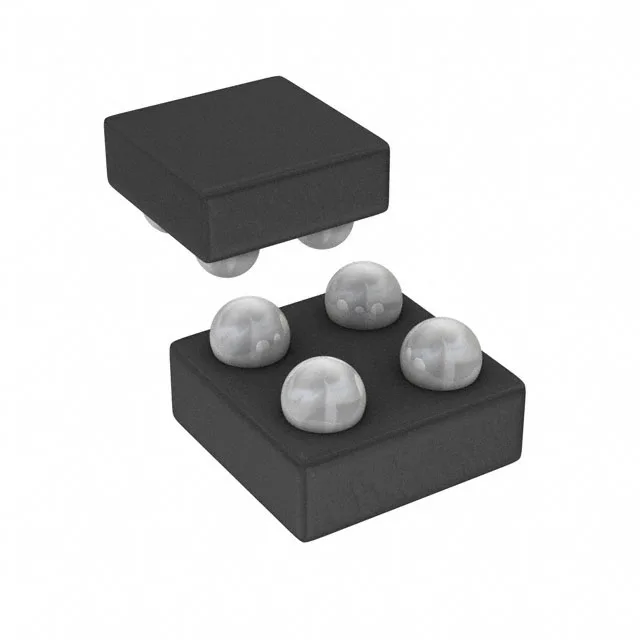
Housed in a 4-ball WLCSP measuring 0.96 x 0.96 mm (supplier device package 4-WLCSP), the footprint is minimal — the die sits directly on the board, so the PCB land pattern must match Analog Devices' recommended layout for reliable solder joint formation. Surface-mount mounting type with an Enable control pin allows the regulator to be gated by a GPIO or power-management IC for sequenced rail startup.
Built-in protection — over-current, over-temp, UVLO
On-chip protection includes over-current limiting, thermal shutdown, and under-voltage lockout (UVLO) — the regulator folds back or shuts down autonomously under fault conditions, reducing the need for external supervisory circuitry.