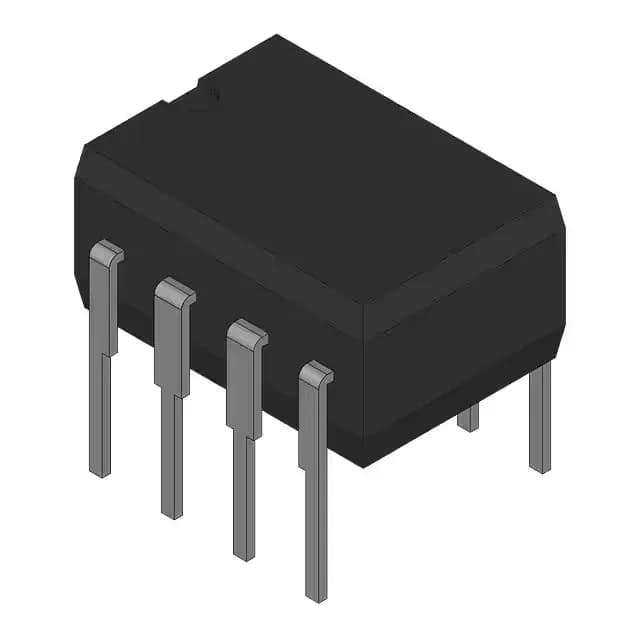
Buck controller in an 8-pin DIP — what you're getting
The ADP1147AN-3.3 is a step-down (buck) switching regulator controller from Analog Devices, designed to drive an external N-channel transistor. It operates as a non-synchronous buck with a single output phase, configured for positive output voltage. The controller integrates current limiting, enable control, and frequency adjustment via the Frequency Control pin. Housed in an 8-pin PDIP (0.300" body, 7.62 mm pitch) with through-hole mounting, this part targets legacy or low-density board designs where SMT reflow is not available or preferred. The supply range spans 3.5 V to 16 V on Vcc/Vdd, and the switching frequency reaches up to 250 kHz — typical for mid-1990s buck controllers, allowing the use of larger inductors and through-hole magnetics.
Temperature grade and deployment boundary
Rated for 0°C to 70°C ambient (TA), this is a commercial-grade part.
Lifecycle and sourcing reality
However, it is marked RoHS non-compliant, which limits its use in designs requiring Pb-free assembly. For new builds with RoHS mandates, a lead-free alternative or a waiver is needed. No official second source or direct successor is recorded in the ledger; the closest functional peer is the surface-mount ADP1864AUJZ-R7, which operates at higher frequency (580 kHz) and wider temperature range (-40°C to 125°C), but is not pin-compatible due to package difference.
What the switching frequency and supply range mean for your BOM
The 250 kHz maximum switching frequency sets the inductor size and output capacitor ripple. The non-synchronous topology means an external Schottky catch diode is required; efficiency suffers at low output voltages compared to synchronous designs, but the controller is simpler and cheaper.