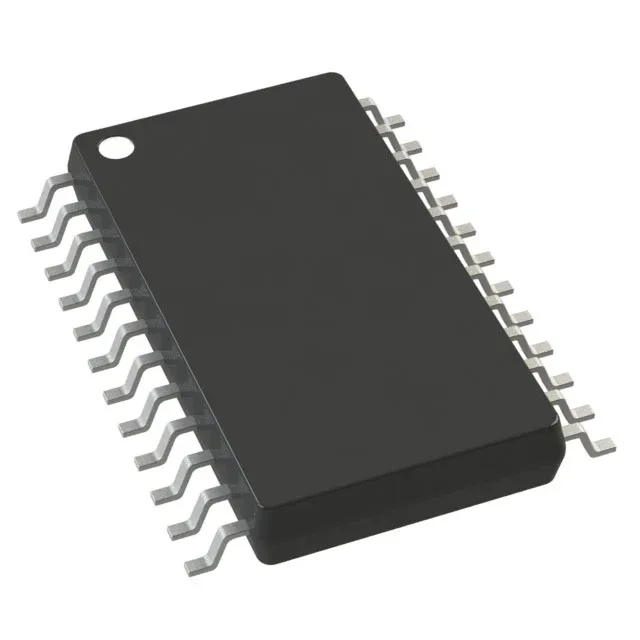
Six-channel gamma buffer purpose-built for TFT-LCD panels
Each of its six circuits delivers a rail-to-rail output with a 7 V/µs slew rate and can source or sink 380 mA per channel, making it capable of driving the column-line capacitive loads in LCD source drivers directly. It comes in a 24-TSSOP package (4.40 mm width) for surface-mount assembly on display driver PCBs.
A typical LCD column has a capacitive load in the hundreds of picofarads to a few nanofarads; the 7 V/µs slew rate combined with 380 mA drive means the output can charge that load quickly enough to settle the gamma voltage between row updates. If your panel's column capacitance or update rate pushes the required slew rate above 7 V/µs, you would need a faster buffer — but for most mainstream TFT panels in the 7-to-15-inch range, this part has the headroom.
Supply current and thermal budget in a six-channel array
The ADD8506WRUZ draws 3.9 mA supply current for all six channels — roughly 650 µA per amplifier. In a gamma buffer array where all six channels may be active simultaneously, that keeps the total dissipation manageable inside the 24-TSSOP package. At 5 V supply and full output swing, the package dissipation stays under a few hundred milliwatts, so no special thermal management is needed on a standard FR4 board with reasonable airflow.
ROHS3 compliance is confirmed, so it passes EU and global environmental requirements without an exemption letter.
Sourcing and provenance screening
As an active, ROHS3-compliant part in a standard 24-TSSOP package, the ADD8506WRUZ is widely available through the authorized distribution channel. When sourcing from the independent market, the date-code laser etch on the 24-TSSOP package should be inspected for font consistency with Analog Devices' marking standards for that assembly site and week. The package marking includes the part number, a date code in YYWW format, and a lot trace code. Any sanded or re-marked surface, or a date code that does not match the manufacturer's production calendar for that plant, is a red flag for counterfeit material. We can provide decap X-ray verification on request for any lot sourced through our desk to confirm die identity and bond-wire configuration.