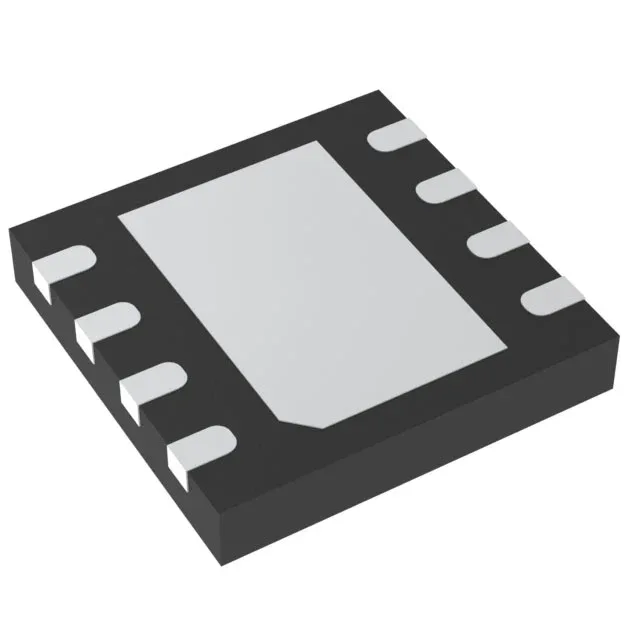
Zero-drift precision in a small package
The ADA4528-2ACPZ-R7 is a dual-channel zero-drift operational amplifier from Analog Devices, built for applications where DC precision matters more than raw speed. Its key differentiator is the 0.3 µV typical input offset voltage — a figure that eliminates the need for external trimming or software calibration in most precision measurement chains. The zero-drift architecture (chopper-stabilized) keeps that offset from drifting with temperature and time, which is what makes this part a fit for thermocouple interfaces, strain-gauge amplifiers, and precision current-sense circuits where a few microvolts of drift would eat into the system error budget. Supply span runs from 2.2 V minimum to 5.5 V maximum, so it works off a single lithium cell or a regulated 5 V bus without a negative rail. Gain-bandwidth product sits at 3.4 MHz with a 0.5 V/µs slew rate — enough for low-frequency sensor conditioning and audio-band filtering, but not a part you'd pick for a high-speed data acquisition front end. The -3 dB bandwidth of 6.5 MHz confirms the same: this is a precision DC and low-frequency AC amplifier, not a video-speed buffer. The supply current per amplifier is 1.5 mA typical, so the total quiescent draw for both channels sits around 3 mA — reasonable for a precision part but not micropower.
This makes it a candidate for outdoor instrumentation, engine-bay sensor conditioning (if not directly on the block), and industrial process control loops that see wide ambient swings. The 125°C upper limit also covers most telecom and datacom equipment enclosures where internal ambient can run hot. The input bias current is 125 pA typical — a JFET-input-like figure that comes from the chopper architecture, not from a JFET front end. That low bias current matters when the source impedance is high, such as in a photodiode transimpedance amplifier or a high-impedance voltage divider. Combined with the 0.3 µV offset, this part can resolve microvolt-level signals from megohm sources without the offset error swamping the reading.