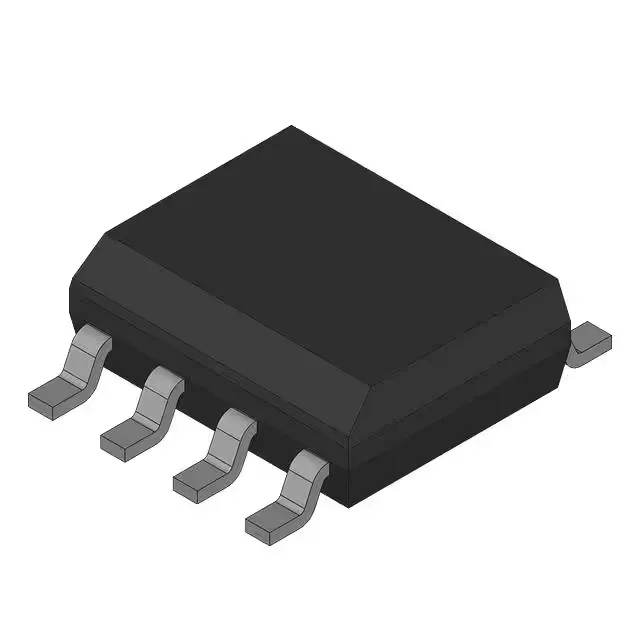
2100 V/µs voltage feedback amp in an 8-SOIC
The supply span runs from 6 V to 11 V, suiting ±5 V or single 8 V/10 V rails.
The 2100 V/µs slew rate is the headline number: it determines how fast the output can swing large voltage steps without slew-induced distortion. For a full-scale 5 V step, that translates to roughly 2.4 ns rise time — fast enough to handle video signals, pulse radar returns, or IF sampling at tens of MHz without significant slew-rate limiting. The 270 MHz bandwidth tells you the small-signal gain is flat to that frequency; beyond it, roll-off sets in. If your application needs gain flatness to 0.1 dB at 50 MHz, this part has the headroom. Input offset voltage is 2 mV typical, and input bias current runs 6 µA — both moderate for a high-speed bipolar stage, but worth budgeting if DC accuracy matters at the ADC input.
The 1.27 mm lead pitch gives good clearance for a fine-tip iron or hot-air nozzle, and the leads are visible for inspection. No exposed pad means no thermal-via stitching is needed, but it also means the junction-to-ambient thermal path relies entirely on the leads and copper trace area. At 23 mA supply current, self-heating is modest, but in a 85°C ambient, keep the copper pour generous under the package.
The catch: it is listed as RoHS non-compliant. For defense, aerospace, or industrial equipment with a RoHS waiver, this is not a blocker. For consumer or medical devices bound for EU markets, a RoHS-compliant alternative like the AD8132WARMZ-R7 (differential amplifier, 360 MHz, 1200 V/µs, automotive grade) may be needed.