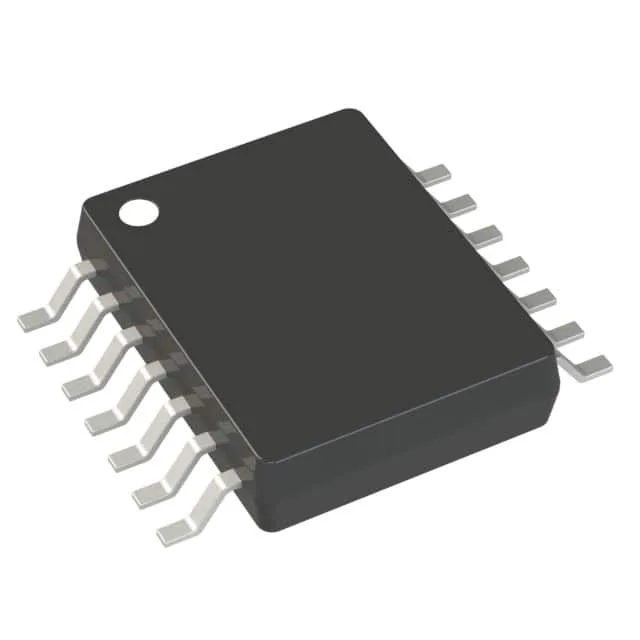
Its headline rating is a 5.5 ns maximum propagation delay — that is the time from input crossing threshold to valid TTL output, measured at 5 V supply. For a designer clocking at 100 MHz, that leaves about half a period of timing margin before the comparator output becomes the bottleneck. The part includes a latch function (the 'with Latch' type) that holds the output state on command, useful for sample-and-hold or zero-crossing capture in closed-loop control.
Dual-channel BOM consolidation vs single-channel AD8611
If you are coming from the single-channel AD8611ARZ (also 5.5 ns, same CMRR/PSRR, same supply range), the AD8612ARUZ doubles the comparator count in the same 14-TSSOP footprint. That saves board area and per-channel cost when you need two fast comparators — for example, window detection or over-current/over-voltage monitoring on separate rails. The single-channel AD8611ARZ still makes sense when you only need one comparator and want to minimise package size (it comes in an 8-pin MSOP or SOIC). The AD8561ARZ is a slower alternative at 9.8 ns propagation delay, with CMOS-capable outputs but only a single element.
Supply range and temperature envelope
The AD8612ARUZ runs on a single 3 V to 5 V supply — no dual-rail needed. The complementary TTL outputs sink and source standard logic levels without extra level shifters.
Package and footprint — 14-TSSOP
Surface-mount only; the tube shipment is typical for prototype and low-volume builds — production quantities may come in tape-and-reel.
ROHS3 compliant. For a production BOM this means no last-time-buy risk on the horizon.