Slew rate and bandwidth — what they mean for signal chain design
At 10 V/µs, the AD8476ARMZ-R7 settles a 5 V step in about 500 ns, which keeps distortion low when driving a 16-bit SAR ADC at 100 kSPS or a 12-bit pipeline ADC at 1 MSPS. The 5 MHz -3 dB bandwidth supports signals up to about 500 kHz with less than 0.1 dB flatness error, adequate for most sensor-conditioning and audio-band applications. If your design needs faster settling for higher-speed converters — say 10 MSPS or above — the AD8475ARMZ-R7 sibling offers 50 V/µs and 150 MHz bandwidth, though at 3 mA supply current versus 330 µA here.
The 3 V minimum supply lets this part run from a 3.3 V rail with headroom, and the 18 V maximum covers 12 V and 15 V industrial supplies. Rail-to-rail output swing means the differential output can reach within millivolts of each supply rail, preserving dynamic range for low-voltage ADC inputs. Each channel can deliver 35 mA, enough to drive a 100 Ω terminated twisted pair or the reference input of a successive-approximation ADC without an extra buffer.
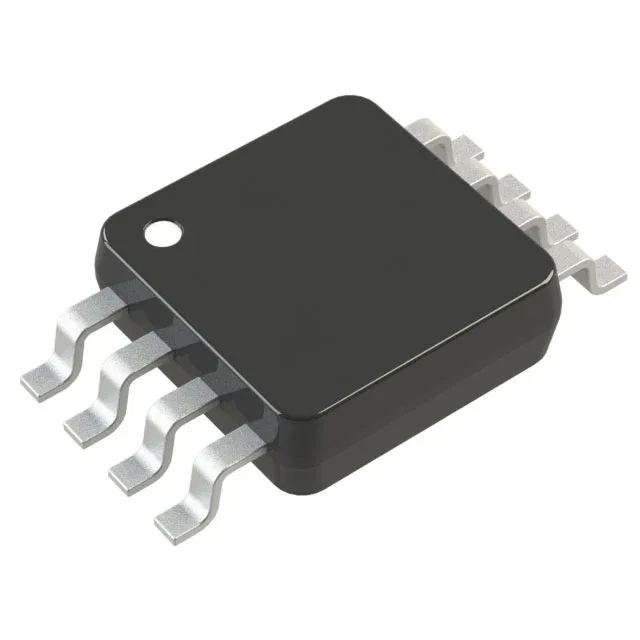
Housed in an 8-MSOP (3.00 mm × 3.00 mm body), the AD8476ARMZ-R7 fits on dense mixed-signal boards alongside ADCs, microcontrollers, or FPGAs.