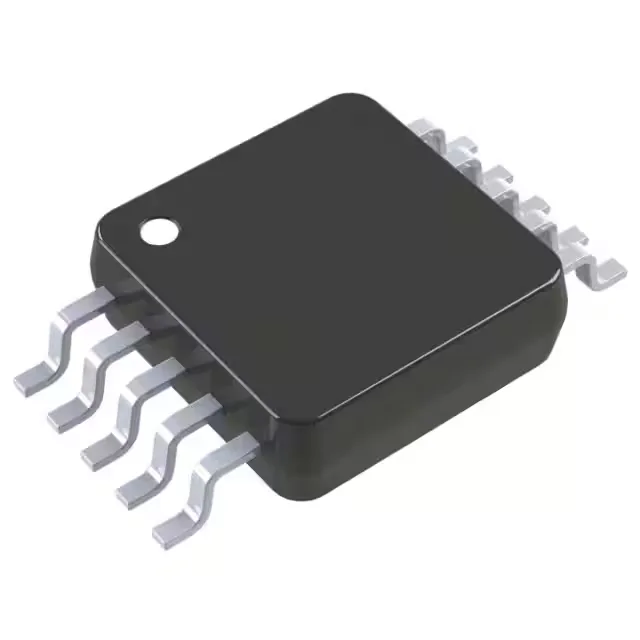
80 V common-mode — where it sits in the system
The AD8417WBRMZ-10RL is a bidirectional current-sense amplifier from Analog Devices that handles an 80 V common-mode voltage range on the input pins, which means it can sit directly on a high-side shunt resistor in a 48 V or 60 V bus without a level-shifting front end. That 80 V rating is the headline spec that decides whether this part fits your BOM or you need a different topology.
The -3 dB bandwidth is 250 kHz, and the slew rate is 1 V/µs. For a current-sense amplifier, that combination tells you the part can track PWM switching edges in a motor drive or a buck converter running at a few hundred kilohertz, but it won't faithfully reproduce a sub-microsecond current spike from a short-circuit event. If your application needs to capture fast overcurrent transients for a comparator trip, you'll want a faster amplifier. The 130 µA input bias current is typical for this class — it's the price you pay for the wide common-mode range.
The supply span is tight — you can't run it off a 12 V rail directly. The input offset voltage is 200 µV, which sets the floor for your measurement accuracy at low shunt voltages. For a 10 mΩ shunt, 200 µV of offset corresponds to 20 mA of reading error before you even account for gain error or noise.