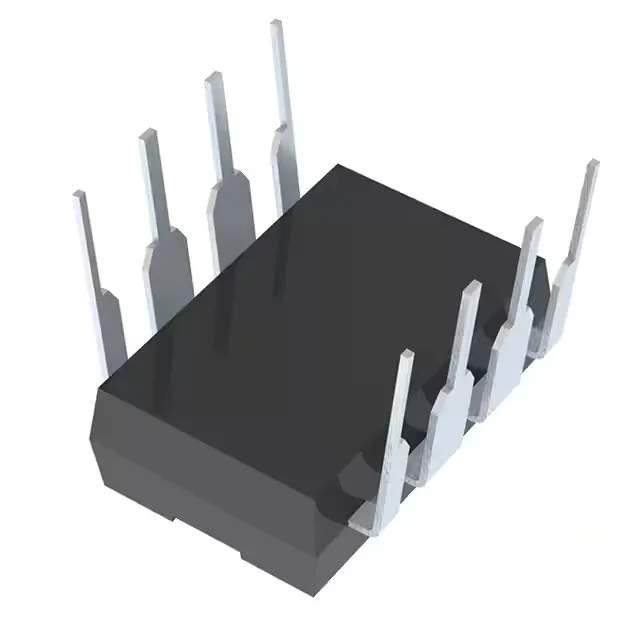
Two circuits in one 8-pin DIP, it drives 60 mA per channel into loads like ADC inputs, video cables, or pulse transformers. Supply span runs from 8 V to 12 V — think ±5 V rails, not a single 5 V or 3.3 V system. The through-hole PDIP package suits breadboard prototyping, socketed evaluation, or legacy through-hole production boards where a surface-mount reflow isn't an option.
A 1400 V/µs slew rate means this amp can swing a 10 V step in about 7 ns. That matters for driving the input of a high-speed ADC where the sample capacitor needs to settle before the conversion window closes, or for amplifying fast pulse trains without slewing into nonlinearity. The 300 MHz small-signal bandwidth supports video line drivers (NTSC/PAL or 720p) and IF amplifier stages in communications receivers.
ADI lists the AD8056ANZ as Active in production. ROHS3 compliant — no exemption-based restrictions. The through-hole DIP variant is less common than the surface-mount AD8056ARMZ (same die, SOIC-8 package), but both remain in the active portfolio. For new designs where board space allows, the DIP is a valid choice; for high-volume pick-and-place, the ARMZ saves assembly steps.