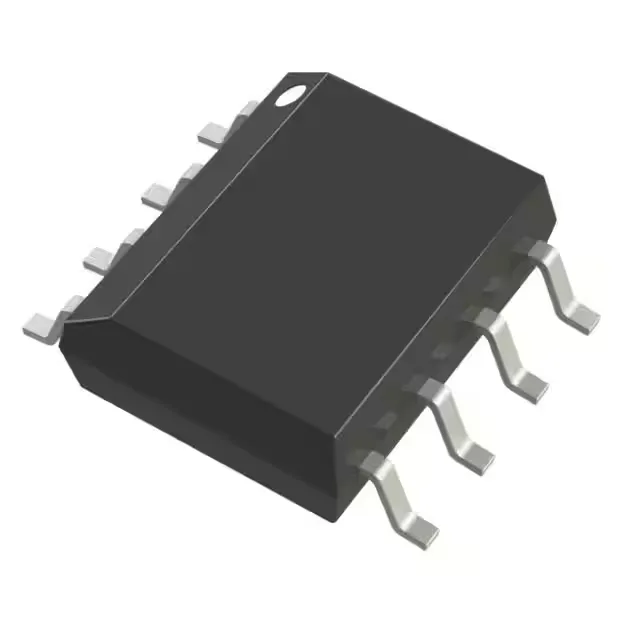
The JFET front end keeps input bias current at 25 pA, which matters when the source impedance is high — think photodiode transimpedance stages or precision integrators where a bipolar input stage would pull the summing node off. The two amplifiers share the same die and supply pins, saving board area versus two single-channel AD711s, and the 9 V to 36 V supply span lets it run from ±5 V to ±18 V rails or a single 12 V or 24 V supply.
Active lifecycle — still a current-production catalog part
Comparing the dual AD712JRZ-REEL to its single and quad siblings
The AD712JRZ-REEL is the dual-channel version of the AD711 family. The single-channel AD711JRZ-REEL7 shares the same 20 V/µs slew rate and 4 MHz bandwidth but draws 2.5 mA supply current versus 5 mA for the dual — about 2.5 mA per amplifier either way. The quad-channel AD713JRZ-16-REEL also matches the slew rate and bandwidth but draws 10 mA total, again 2.5 mA per amplifier. All three use the same JFET input topology with 300 µV offset, so the choice is purely channel count per package: two in the 8-SOIC AD712, four in the 16-SOIC AD713.