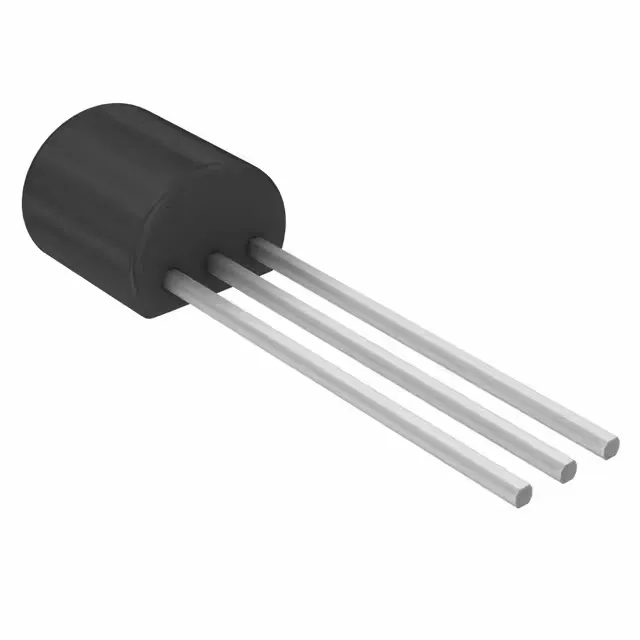
Analog Devices AD592BNZ — Discrete Semiconductors

AD592BNZ Analog Temperature Sensor, ±1°C Accuracy, TO-92-3

MPNAD592BNZ
End of Life

Analog Devices AD592BNZ, Analog Current Output Temperature Sensor, Analog Local Sensor Type, ±1°C Accuracy at 25°C, -25°C to 105°C Range, 4V to 30V Supply, Through Hole, TO-226-3 / TO-92-3 (TO-226AA) Package, Bulk.

$30.49Ref. price · indicative, final on quote
PackagingTO-226-3, TO-92-3 (TO-226AA)
StockContact for availability
MOQ1 pcs
  • 100% new & originalTraceable channels only — no refurbs, no pulls, no remarked parts.
  • Date & lot codes on quoteStated per line before you commit; label photos on request.
  • MSL-compliant ESD packingMoisture-sealed bags with indicator cards; reels photo-verified.
  • PayPal buyer protectionPay by T/T, PayPal or Payoneer — card payments covered end to end.

Specifications

AD592BNZ Technical Specifications
ParameterValue
Output typeAnalog Current
Sensor typeAnalog, Local
Mounting typeThrough Hole
Voltage4V ~ 30V
Operating temperature-25°C ~ 105°C
PackageBulk
CaseTO-226-3, TO-92-3 (TO-226AA)
Test condition25°C
Accuracy - highest (Lowest)±1°C
Sensing temperature - local-25°C ~ 105°C

Product details

Analog current output, ±1°C — what this sensor delivers

The AD592BNZ is a precision analog temperature sensor from Analog Devices that outputs a current proportional to absolute temperature. It covers a local sensing range of -25°C to 105°C with a typical accuracy of ±1°C at 25°C, making it a direct-fit choice for temperature monitoring in industrial controls, HVAC systems, and instrumentation where a linear current signal simplifies interface design. The sensor runs on a 4V to 30V supply, which means it can be powered from a standard 5V logic rail, a 12V industrial bus, or a 24V loop supply without an extra regulator. The output is a ratiometric current — typically 1 µA per Kelvin — so a simple resistor to ground converts it to a voltage for any ADC input. Housed in a TO-92-3 through-hole package, the AD592BNZ is easy to mount on a PCB or attach to a heat sink with epoxy. The three-lead plastic body is a standard footprint shared by many temperature sensors, so board layout is straightforward for prototype or production runs.

Accuracy grade: why the BNZ suffix matters

The AD592BNZ is rated at ±1°C at 25°C. The AD592ANZ sibling is specified at ±2.5°C at the same test condition.

Active lifecycle — no LTB risk for new builds

The AD592BNZ carries an active product status with ROHS3 compliance. There is no last-time-buy window to track and no imminent obsolescence concern for production programs. This part can be specified for new designs and multi-year builds without a forced redesign cycle.

Frequently asked questions

What is the accuracy of AD592BNZ?

The AD592BNZ is rated at ±1°C accuracy at 25°C. This is the tightest grade in the AD592 family, suitable for applications requiring better than ±2.5°C precision.

What is the replacement or equivalent for AD592BNZ?

The AD592ANZ is the lower-accuracy sibling (±2.5°C at 25°C) in the same TO-92-3 package and pinout. For a direct drop-in with identical accuracy, the AD592BNZ itself is the current active grade — no replacement is needed.

What is the output type of AD592BNZ?

The AD592BNZ outputs an analog current proportional to absolute temperature, typically 1 µA per Kelvin. This current-mode signal is immune to voltage drops across long cable runs, making it suitable for remote sensing.